Construction
Jul 2, 2026
WA Security of Payment 101: A Guide for High-End Builders
WA Security of Payment 101: A Guide for High-End Builders

WA Security of Payment 101: A Guide for High-End Builders
Cash flow is the lifeblood of any high-end residential project. But in the world of custom builds and major renovations, the gap between "work completed" and "money in the bank" can often feel like a canyon.
If you signed a contract in Western Australia after 1 August 2022, the rules of the game have changed significantly. The Building and Construction Industry (Security of Payment) Act 2021 (WA): commonly referred to as the SOP Act: is now in full swing. It’s designed to ensure you get paid on time, every time, by providing a statutory "fast-track" to recovery.
However, for high-end builders dealing directly with homeowners, there are specific traps that can invalidate your claims before you even hit 'send' on an invoice.
At Shoal Bay Projects, we see these compliance gaps daily. Here is your forensic guide to navigating the WA Security of Payment Act without losing your margin: or your mind.
Before August 2022, WA relied on the Construction Contracts Act 2004. It was "fine," but it lacked the teeth found in other states. The new 2021 Act brought WA into alignment with a national "East Coast" model of security of payment, making it much harder for principals (homeowners) to sit on your cash.
Check your dates. If your contract was signed before 1 August 2022, the old rules apply. If it was signed on or after that date, you are playing by the new rules. Given the national target to build 1.2 million homes over the next five years, the regulator is tightening the screws on payment transparency. You cannot afford to use "legacy" invoicing templates that don't reference the new legislation.
In the high-end residential space, most of your contracts likely exceed the $500,000 (inclusive of GST) mark. This is a critical legal "trigger point" in Western Australia.
Under the Act, if you are working for a "natural person" (an individual or couple, rather than a company) on a project involving one or two dwellings:
This is where many builders stumble. If you submit a $40,000 progress claim on a $1.2M mansion build and forget to attach that specific, prescribed PDF notice, your claim is invalid under the Act. You lose your right to rapid adjudication and the ability to turn that invoice into a statutory debt.
Action Item: Download the prescribed Homeowner’s Notice from the Building and Energy website and make it a permanent attachment to your progress claim email template.
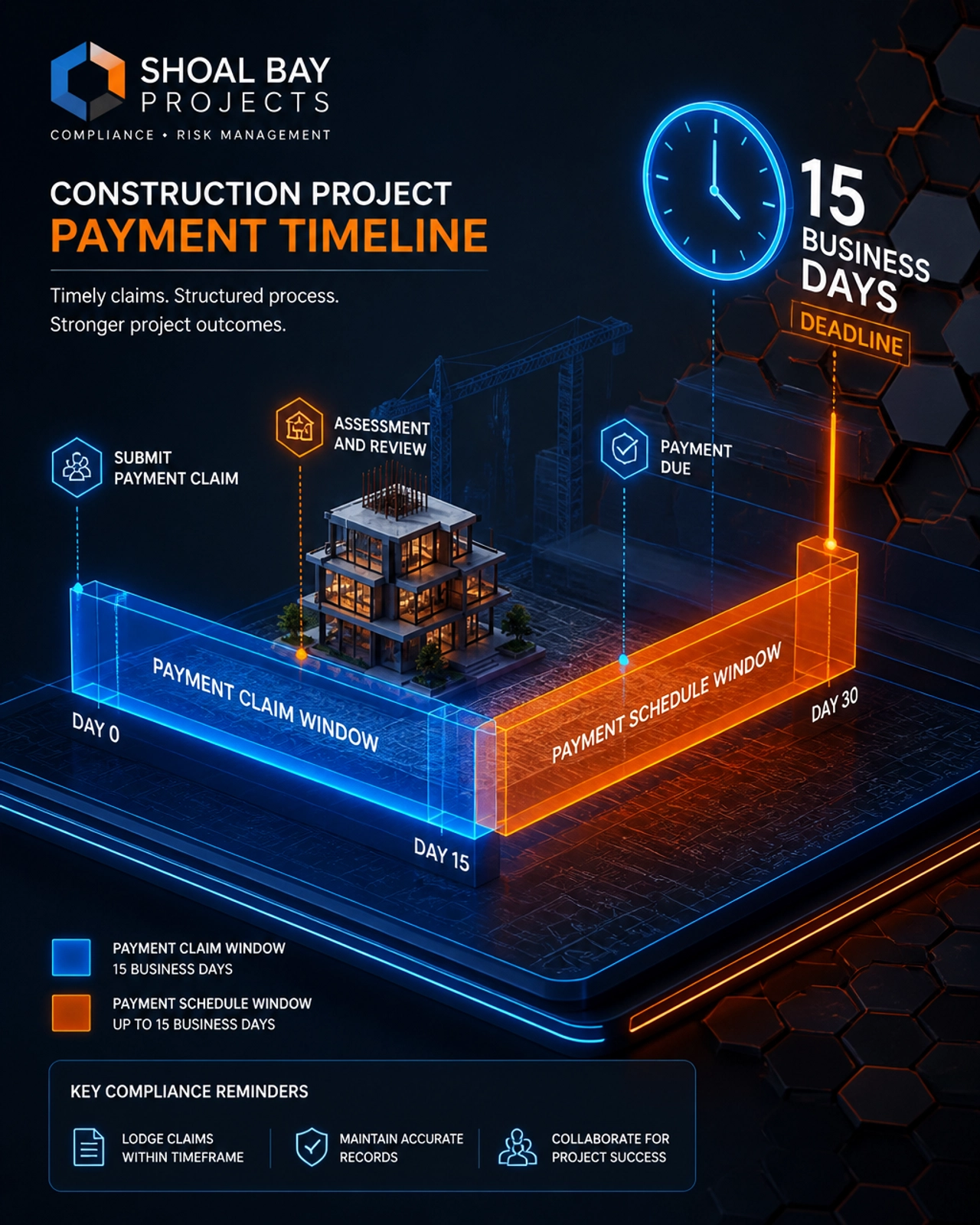
The most powerful tool in your arsenal is the Payment Schedule. Once you serve a valid payment claim, the clock starts ticking for the homeowner.
In the eyes of the law, the debt becomes "statutory." The homeowner cannot later turn around during a court or adjudication process and say, "But the tiles are crooked!" If they didn't put those reasons in a Payment Schedule within 15 business days, they have effectively waived their right to argue about the amount in that specific payment cycle.
Document everything. The 15-day clock starts from the moment the claim is received. If you're emailing invoices at 9:00 PM on a Friday, make sure your contract defines when "service" is deemed to have occurred.
While you have 15 business days to wait for a schedule, the actual due date for payment is often sooner.
Under the SOP Act, for home building work (where the owner is the principal):
If you are a high-end builder, your cash flow depends on these dates. Specify clear payment terms in your residential contracts that align with the Act's default of 10 business days. This keeps the pressure on the principal to stay liquid.
What happens when the homeowner sends a Payment Schedule that says "I’m only paying $5,000 of your $50,000 claim because I don't like the finish on the cabinetry"?
This is where Adjudication comes in. Adjudication is a "rough and ready" dispute resolution process that takes weeks, not months or years.
Adjudication is "interim." It doesn't stop the homeowner from suing you later for a "final" determination, but it ensures that money flows now and the lawyers fight later. For a builder, "Pay Now, Fight Later" is the greatest protection you have against a client trying to use your cash flow as leverage.

Navigating the technicalities of the SOP Act is just one part of protecting your business. We have built a community and a resource library specifically for builders who want to move from "running a job" to "running a high-performance construction company."
We invite you to explore The Hive and The Vault: our structured advisory hubs where we deep-dive into compliance, risk management, and the finer details of the NCC.
Explore the Hive: Watch the Welcome Video
Don't wait for a payment dispute to fix your processes. Take these steps today:
The WA Security of Payment Act is a shield, but you have to know how to hold it. For medium to high-end builders, the $500,000 threshold and the Homeowner’s Notice requirement are the two biggest hurdles.
Master the paperwork, respect the 15-day clock, and ensure your contracts are aligned with the 2021 legislation. If you’re unsure if your current progress claim process is compliant, reach out for a structured advisory session. We’ll help you find the gaps before they become bad debts.