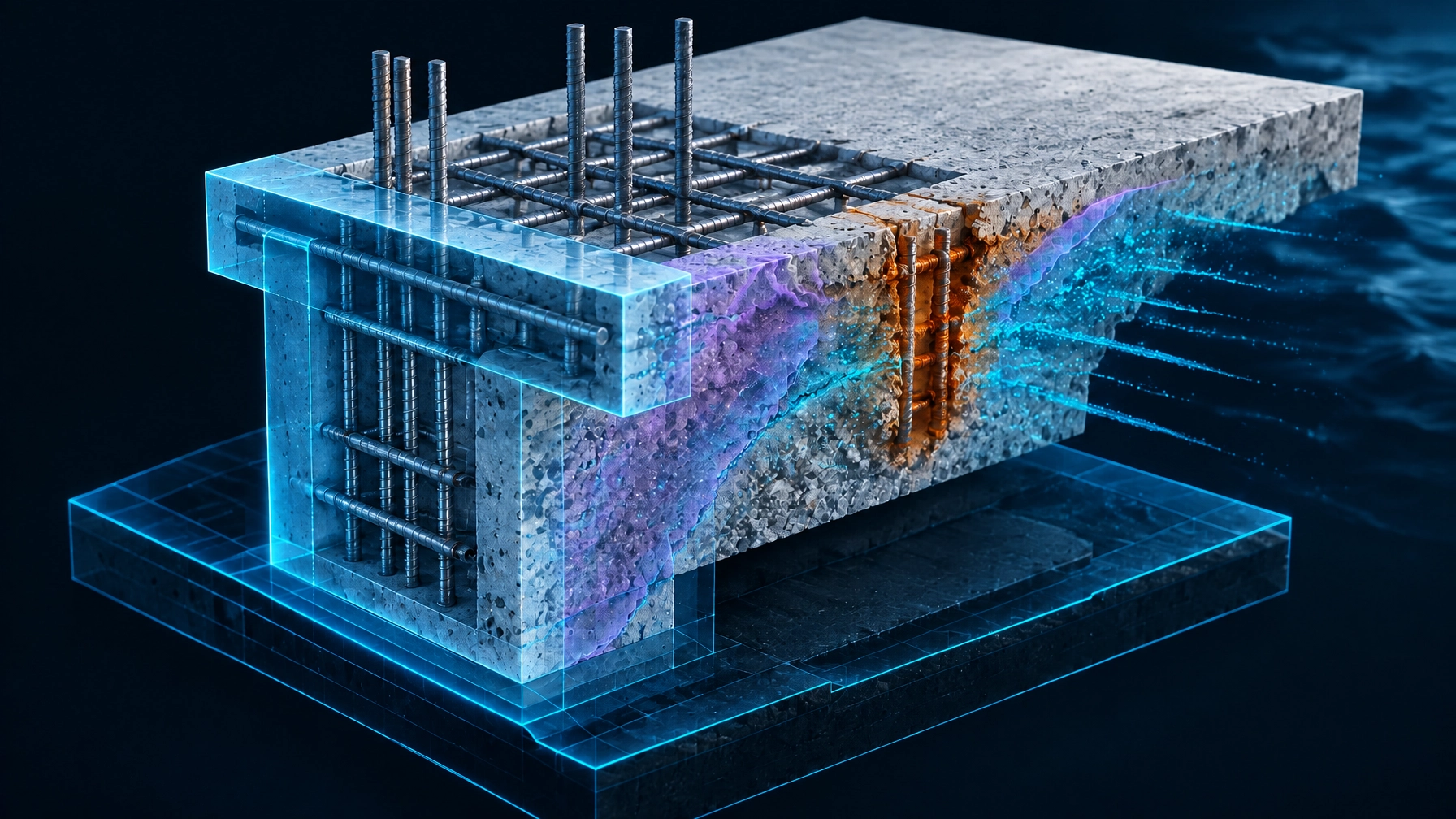
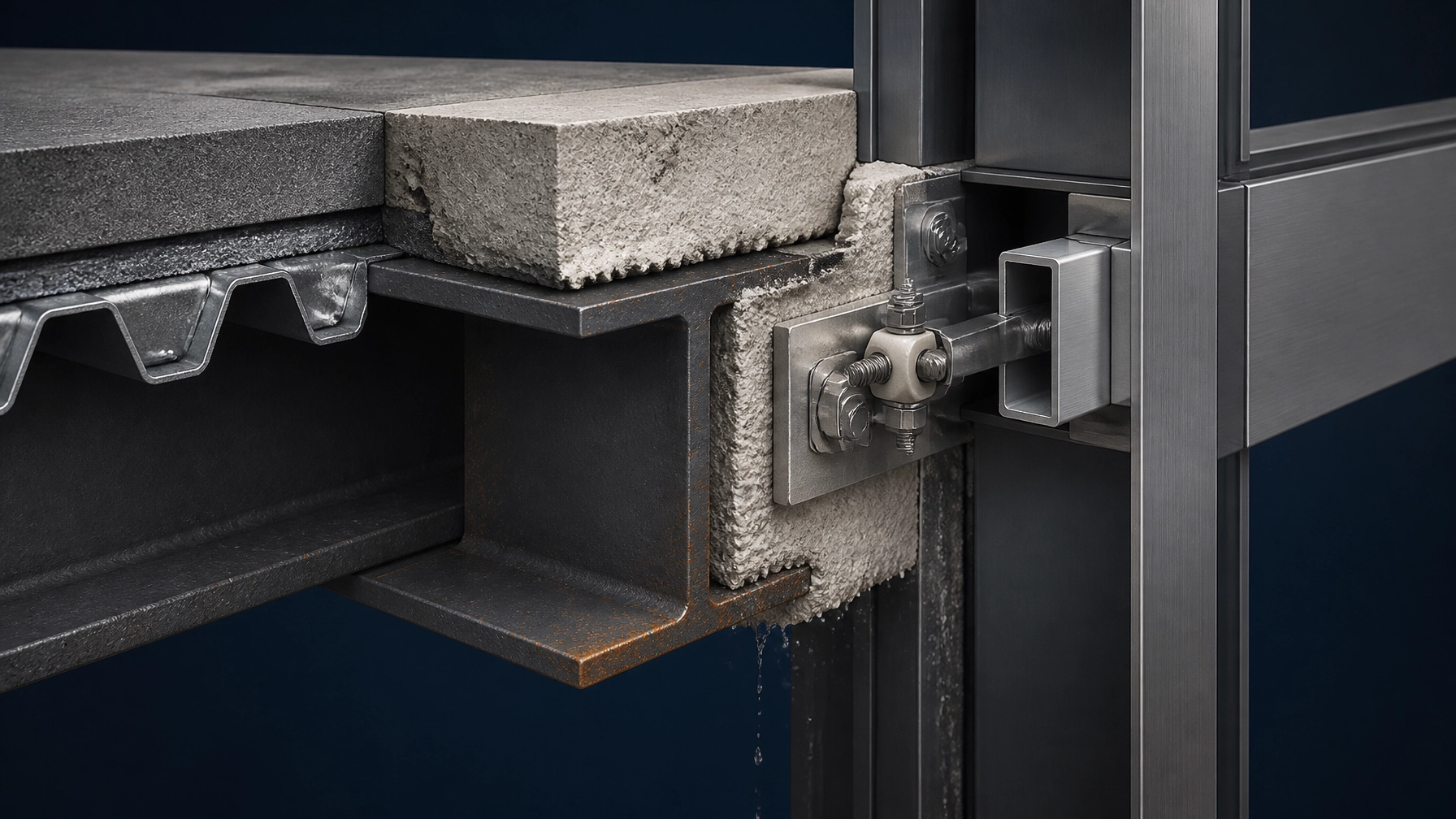
A high concrete strength specification can create a false sense of security.
It may satisfy a compressive-strength target, support a premium design narrative and appear to demonstrate rigorous quality control. Yet if reinforcement is positioned too close to the surface, the durability design may already be compromised before the concrete reaches its specified strength.
For high-end residential construction in Dubai, Singapore, the UK and other hot-humid or marine environments, reinforcement position is not a minor placement detail. It is a primary durability control.
The critical question is not only:
“What strength concrete was ordered?”
It is also:
“How much effective cover was actually achieved around the reinforcement?”
Problem: Specified cover is not achieved cover
Design documents typically nominate a required concrete cover. That value is used to create a physical barrier between the reinforcement and environmental agents such as carbon dioxide, moisture, chlorides and oxygen.
The construction site produces a different variable: achieved cover.
The gap between these two values is where many durability failures begin.
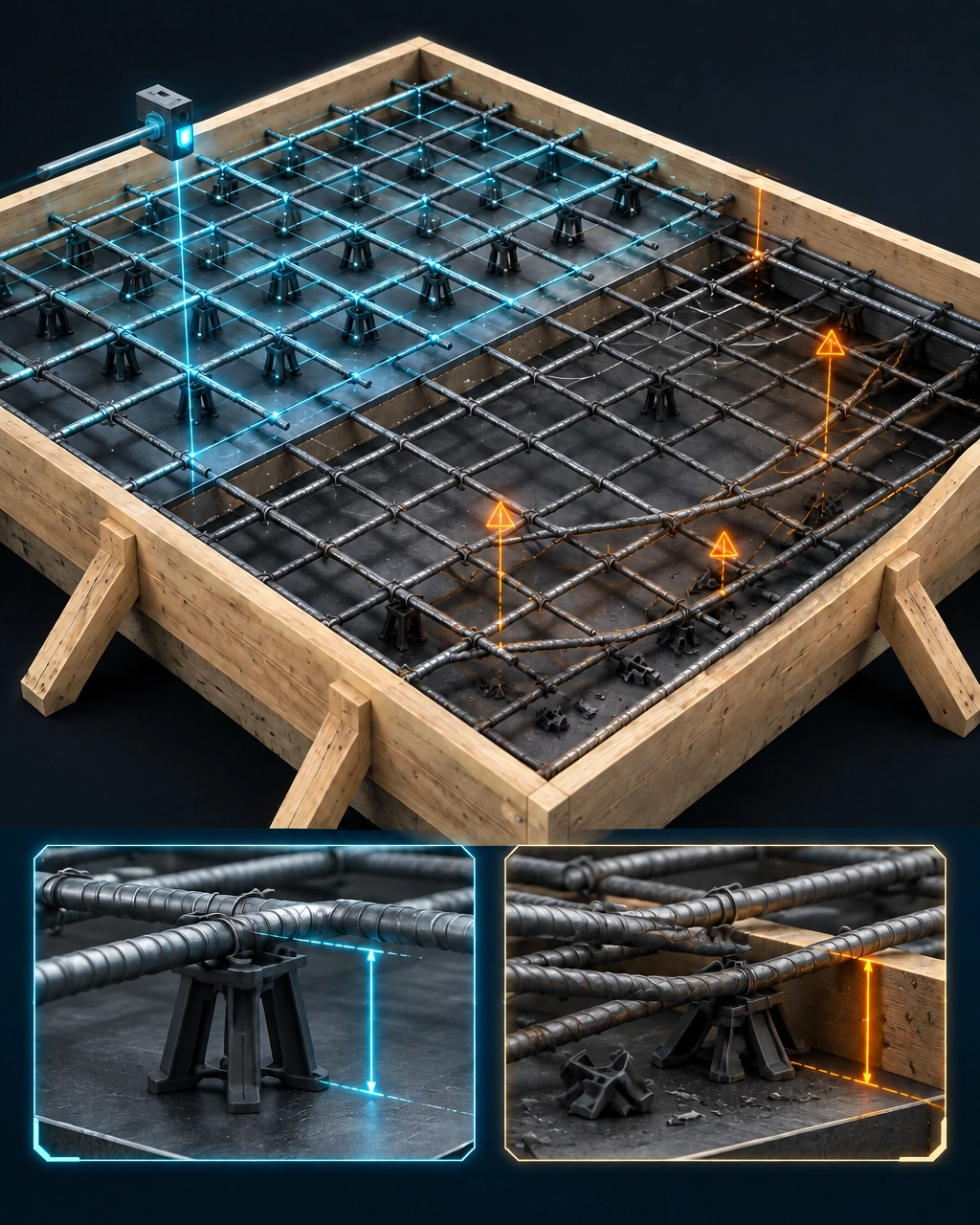
Reinforcement may be displaced by:
- Inadequate or unstable spacers
- Excessive worker traffic across the reinforcement
- Poorly supported mesh or bars
- Formwork movement
- Incorrect bar chairs or support spacing
- Pump-hose impact during placement
- Concrete vibration
- Congested reinforcement zones
- Last-minute changes made without engineering review
A slab can therefore receive high-grade concrete while the reinforcement remains materially closer to the exposed surface than the design intended.
The finished surface may still appear acceptable. The concrete may be smooth, level and visually consistent. That appearance does not prove that the reinforcement is in the correct position.
This is a recurring source of friction between contractors, consultants, owners and oversight bodies. The contractor may point to concrete delivery dockets and compressive-strength results. The reviewer may identify deficient cover through drawings, scans, exposure investigations or corrosion evidence. Both may be discussing quality, but they are measuring different risks.
Surface finish is not a substitute for structural durability compliance.
Forensic Analysis: Why reinforcement position controls durability
Concrete cover performs as a barrier.
It provides distance that environmental agents must travel before reaching the steel. The greater the effective distance, the longer the potential initiation period: provided the concrete is adequately compacted, cured and controlled for cracking.
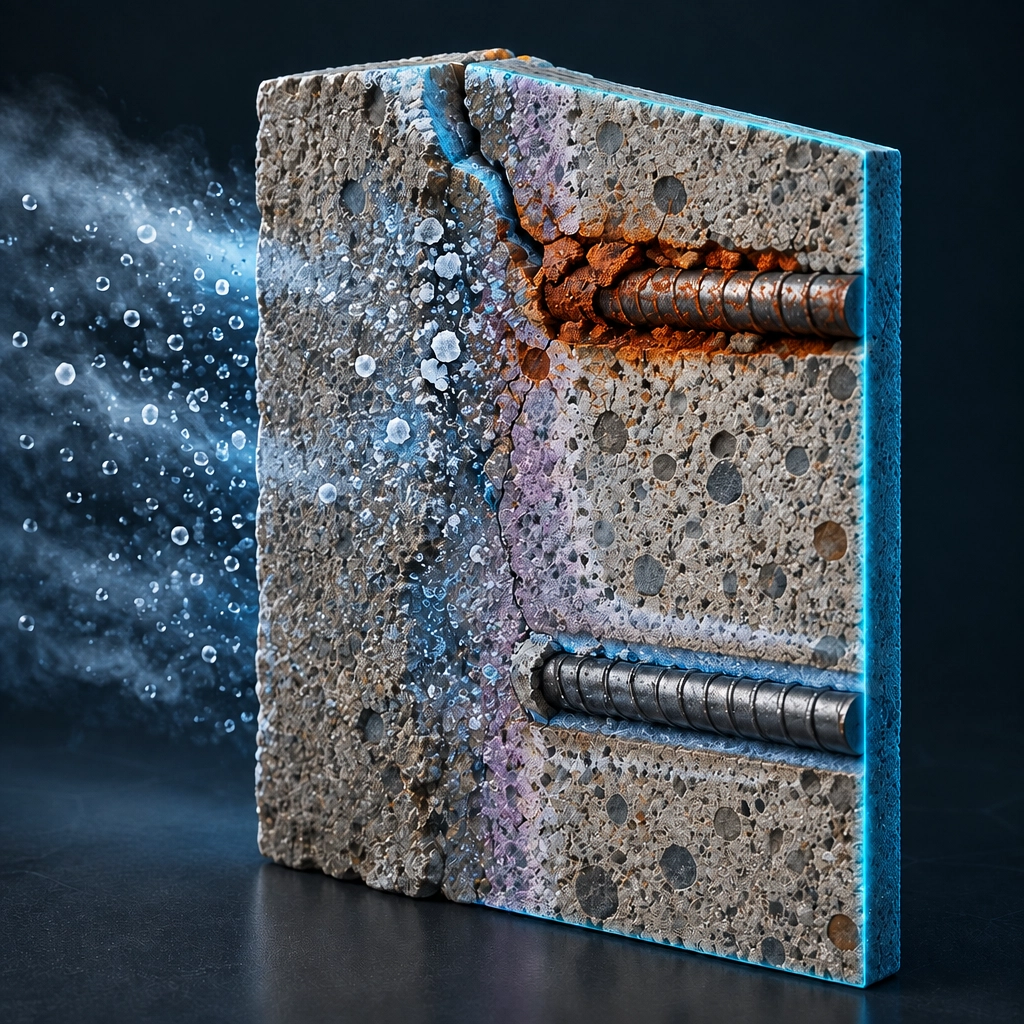
Carbonation advances from the surface inward
Carbonation occurs when carbon dioxide penetrates concrete and reacts with alkaline components in the cement paste. As carbonation progresses, the alkalinity surrounding reinforcement can fall below the level required to maintain the steel’s passive protective condition.
Once the carbonation front reaches reinforcement, corrosion risk increases significantly, particularly where moisture and oxygen are available.
The governing relationship is not simply “strong concrete equals durable concrete.” Carbonation depth is influenced by:
- Effective cover depth
- Concrete permeability
- Curing quality
- Relative humidity
- Cracking
- Cementitious composition
- Exposure duration
A shallow reinforcement position shortens the distance the carbonation front must travel. A high-strength mix may reduce permeability, but it does not restore cover that was never achieved.
Chlorides exploit the shortest available path
In marine or salt-laden environments, chloride ions can migrate through concrete and eventually reach the reinforcement. This is particularly relevant to coastal villas, podium slabs, balconies, swimming-pool structures, basement interfaces and exposed architectural concrete.
Chloride-induced corrosion does not require the concrete to be weak. It requires the chloride concentration at the steel surface to exceed a critical threshold, combined with conditions that allow corrosion to develop.
The main variables include:
- Chloride exposure
- Concrete permeability
- Cracking and connected porosity
- Moisture conditions
- Effective cover
- Reinforcement position
- Curing and placement quality
Where the reinforcement is too close to the surface, the chloride travel path is reduced. The durability model is then being applied to a geometry that was not actually built.
ASTM C1202 can provide an electrical indication of chloride ion penetrability. ASTM C1556 can be used to determine an apparent chloride diffusion coefficient by bulk diffusion. These tests help characterise the concrete. They do not, by themselves, confirm that reinforcement was installed at the specified depth.
High strength cannot compensate for misplaced steel
High-strength concrete can offer valuable performance benefits, including improved compressive capacity and, in some mixes, reduced permeability. It does not eliminate the effect of deficient cover.
This distinction is central to construction risk management services.
A project team may attempt to defend a low-cover condition by citing:
- Higher-than-specified compressive strength
- Low water-to-cementitious-material ratio
- Additional cementitious materials
- Surface sealers
- Coated reinforcement
- A visually satisfactory finish
Those factors may influence durability, but they do not automatically invalidate the original cover requirement or demonstrate equivalent performance.
The correct forensic question is whether the installed condition satisfies the design intent and the applicable durability model: not whether another favourable material property can be identified after the fact.
Standard Reference: What the international framework requires
ACI 318: durability and reinforcement detailing
ACI 318-19(22) addresses structural concrete design and construction, including durability, cover, reinforcement detailing, construction documents, inspection and field testing.
Its durability framework treats cover as a deliberate design parameter. The required cover depends on the member, reinforcement arrangement and exposure condition. The nominated value is not decorative. It forms part of the protection strategy for embedded steel.
ACI 318 also recognises that durability depends on more than compressive strength. Concrete quality, exposure, permeability, cracking, reinforcement detailing and construction execution must be assessed together.
ACI 117: tolerances do not remove the inspection obligation
ACI 117 establishes tolerances for concrete construction and materials, including reinforcement location.
A tolerance is not permission to ignore reinforcement position. It is a controlled limit within which construction variation may be accepted, subject to the governing design and specification.
The practical issue is that tolerances can consume the durability margin. If the specified cover is close to the minimum required value and reinforcement is placed toward the exposed face, a nominally permitted deviation may create an unacceptable achieved condition.
This is why design teams should distinguish between:
- Minimum required cover
- Specified or nominal cover
- Construction tolerance
- Measured achieved cover
- Actual durability risk
ASTM and ISO durability testing
Use ASTM C1202 as a rapid indicator of chloride ion penetrability where appropriate. Use ASTM C1556, ASTM C1543 and ASTM C1152/C1152M when deeper investigation of chloride diffusion and chloride content is required.
ISO 16204 provides a service-life design framework for concrete structures subjected to environmental deterioration.
ISO 1920-11 addresses testing the resistance of concrete to chloride penetration by unidirectional diffusion.
These standards support a critical distinction:
Test the material. Measure the geometry. Assess the exposure. Then determine the risk.
No single concrete test can substitute for verification of reinforcement position.
Actionable Fix: Control the position before the pour
Treat reinforcement position as a controlled construction activity, not an informal pre-pour observation.
1. Define the durability-critical zones
Identify areas where low cover would have disproportionate consequences:
- External slabs and balconies
- Coastal or marine-facing elements
- Pool structures
- Basement walls
- Roof slabs
- Columns exposed to humid air
- Architectural concrete with limited protective finishes
- Cracked or highly restrained elements
- Congested beam-column interfaces
Mark these zones on inspection plans and require targeted verification.
2. Specify the support system
Do not merely state the required cover. Define how the reinforcement will be supported.
Document:
- Spacer type and suitability
- Support spacing
- Load stability
- Compatibility with reinforcement size
- Resistance to movement during placement
- Inspection access
- Requirements for replacement of displaced supports
Require the contractor to demonstrate that the system can maintain position during the full concrete placement sequence.
3. Inspect before and during placement
A single pre-pour inspection may not be enough.
Use hold points before concrete placement and monitor high-risk areas while placement is underway. Record:
- Reinforcement location
- Spacer condition
- Formwork dimensions
- Clearances at penetrations and edges
- Changes made on site
- Areas affected by worker or hose movement
- Any reinforcement that was lifted, cut, shifted or re-supported
4. Measure achieved cover
Where the risk profile justifies it, use suitable non-destructive cover measurement after the concrete has hardened. Combine scan results with drawings, photographs, core investigations or local exposure where necessary.
Do not treat a scan as an isolated number. Interpret it against the design cover, tolerance, exposure condition, member function and evidence of cracking or corrosion.
5. Separate appearance defects from durability defects
A finish review may identify honeycombing, staining, blowholes or patching. A durability review must also ask:
- Is the reinforcement at the correct depth?
- Has cover been reduced at edges, corners or penetrations?
- Is there evidence of cracking connected to reinforcement?
- Has carbonation reached the steel?
- Are chloride concentrations elevated at reinforcement depth?
- Does the remedial proposal restore the design intent?
This is where a building dispute consultant or specialist residential building consultant adds value. The issue is not simply whether a defect is visible. It is whether the installed condition creates a measurable compliance, service-life or financial risk.
6. Match the audit model to the risk
A desktop document audit may verify drawings and concrete records, but it cannot confirm hidden reinforcement position.
A final visual inspection may confirm finish quality, but it may miss an internal durability defect.
For risk-sensitive work, use a layered model:
- Design and specification review
- Pre-pour reinforcement inspection
- Placement-stage monitoring in critical areas
- Post-pour cover verification
- Targeted durability testing where exposure or evidence warrants it
- Independent forensic review where liability is contested
This approach reduces the likelihood that a disagreement between contractor and oversight body escalates into a delay, rectification dispute or legal claim.
The director-level conclusion
Concrete strength matters. It is not the whole durability strategy.
The reinforcement must be positioned so that the specified cover is actually achieved. Spacers must maintain that position. Inspection must verify it. Testing must be interpreted alongside the geometry and exposure.
A high-strength concrete mix with shallow reinforcement can still present a serious durability risk. A visually flawless finish can still conceal a compliance failure. A concrete delivery record can confirm the material supplied, but not the location of the steel inside the finished element.
Control the cover. Measure the achieved position. Document the evidence before the dispute begins.
For more forensic construction intelligence, visit the Shoal Bay Projects website and subscribe to the Shoal Bay Projects Hive YouTube channel.
⚠️ The image in this post is used for illustration purposes only, designed to encourage thoughtful discussion. It is not intended to represent a prescriptive detail of any installation or construction method.
Circle-ready pack
Conversational introduction
A high concrete grade does not automatically create a durable structure.
The real durability question is often hidden inside the slab, beam or wall: did the reinforcement remain at the specified position, or did it move closer to the exposed surface during construction?
This article examines the forensic gap between specified cover and achieved cover, including spacer discipline, carbonation, chloride ingress and the audit models that can either prevent or amplify a construction dispute.
Title:
The Cover Illusion: Why Reinforcement Position : Not Concrete Strength : Predicts Structural Durability in High-End Residential Construction
Key forensic takeaways
- High concrete strength can reduce permeability, but it cannot restore deficient reinforcement cover.
- Spacer instability, worker traffic, formwork movement and concrete placement can reduce achieved cover before the concrete hardens.
- ACI 318 and ACI 117 must be applied through coordinated design review, placement inspection, measurement and evidence-based durability assessment.
- ASTM and ISO durability tests characterise material performance; they do not replace verification of reinforcement position.
Image assets
Watch the Hive
Subscribe to the Shoal Bay Projects Hive YouTube channel →
Claim Your Foundation Membership
The Vault. The App. The Community. We're opening the doors to a select group of Foundation Members : free, for a limited time. Foundation Membership includes full access to The Vault (our forensic intelligence archive) and early access to the Hive app.
Once the charter window closes, this tier is gone permanently. Foundation Members retain access for life. This is not a trial ; it's a permanent invitation to the founding cohort.
Claim Your Foundation Membership →