Construction
Jul 2, 2026
The Homeowner’s Checklist: Understanding Progress Payments and Payment Schedules
The Homeowner’s Checklist: Understanding Progress Payments and Payment Schedules

The Homeowner’s Checklist: Understanding Progress Payments and Payment Schedules
Building a high-end custom home is a significant financial undertaking.
Unlike a standard off-the-plan build, custom residential projects often involve complex architectural details, premium materials, and multi-stage payment structures that can span several years.
For the homeowner, the most critical "business" aspect of the project occurs when a progress claim lands in your inbox. In Australia, the legal and contractual framework surrounding these payments is strict. If you are a respondent to a payment claim, you cannot simply ignore an amount you disagree with. You must provide a formal Payment Schedule.
At Shoal Bay Projects, we specialize in guiding homeowners through these technicalities, ensuring that every dollar paid aligns with the actual value of work performed on-site. This checklist serves as your roadmap to managing cashflow, mitigating the risk of "front-loading," and understanding your rights under the Security of Payment legislation.
A progress claim is more than just an invoice. In the context of a high-end build, it is a formal demand for payment for work performed during a specific period or upon reaching a defined milestone.
Most premium builds utilize contracts such as AS 4906 (Minor Works) or tailored residential agreements that include specific provisions for payment claims. Under the Security of Payment Act (which varies slightly by state but maintains core national principles), a valid payment claim must:
Check: Ensure the builder has attached any required "Homeowner's Notice" if your project value exceeds the statutory threshold (e.g., $500,000 in certain jurisdictions). Without this notice, the claim may be invalid under the Act, though you may still be contractually liable.
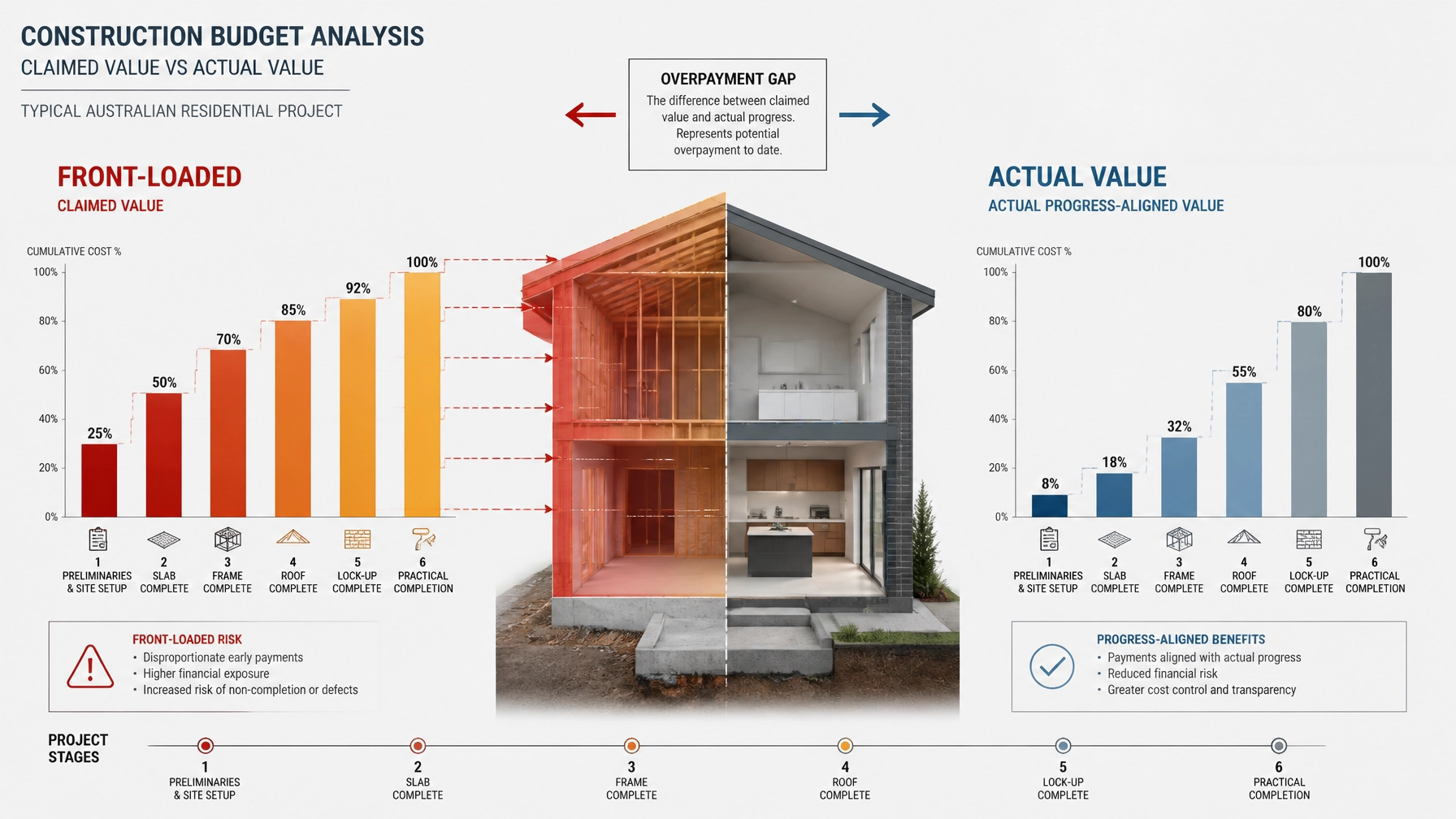
"Front-loading" occurs when a builder allocates a disproportionately high value to the early stages of a project: such as site establishment, demolition, or the initial slab: relative to the actual cost of those works.
If you overpay in the first 20% of the project, you lose your financial leverage. Should the builder face insolvency or abandonment issues mid-way through the build, you will find that the remaining funds in your budget are insufficient to pay a new contractor to finish the work.
Specify: Always compare the claimed percentage of a stage against the physical reality. If the builder claims 100% of "Preliminaries" in the first month, they are front-loading their profit.
If you receive a progress claim and you do not intend to pay the full amount, you are legally obligated to provide a Payment Schedule.
This is not a casual email saying, "I'll pay you next week." A Payment Schedule is a formal document that:
Document: In many Australian jurisdictions, you have a strict window: often 10 to 15 business days: to serve this schedule. If you miss this deadline, you may become automatically liable for the full amount of the builder's claim, regardless of whether the work was actually done or if it was defective.
In a high-end project, cashflow management is about protecting your "cost-to-complete." You need to ensure that at every stage of the build, the remaining contract sum is enough to pay another builder to finish the house if your current builder disappears.
Verify: Before making any payment, cross-reference the claim against the Bill of Quantities (BoQ) or the Schedule of Rates. If your contract is "Lump Sum," check the percentage completion against the agreed milestones.
For most homeowners, assessing whether a "Plateau Level" masonry claim is technically accurate is impossible. This is where Shoal Bay Projects provides a critical layer of defense.
We operate at the advisory level to:
Seek Advice: If a builder serves a claim under the Security of Payment Act, the clock is ticking. Engaging a consultant early allows you to respond with precision rather than emotion.
Follow these steps every time a claim arrives:
Progress payments should be a celebration of a milestone reached, not a source of anxiety. By understanding the requirement for a Payment Schedule and the risks of front-loading, you move from a passive "payer" to an active "project manager" of your own investment.
Protect your project, maintain your leverage, and ensure your high-end build remains a legacy of quality rather than a lesson in financial risk.
If you’re currently navigating a complex build or have just received a progress claim that doesn't feel right, we invite you to explore our community hub. Gain access to technical insights, compliance templates, and expert advisory designed to protect your home.
Explore The Hive & The Vault here