Problem: A Correct Product Installed in the Wrong Position
Vapour control failures are rarely caused by the absence of a membrane specification. More often, the specified product is technically suitable, but its position, continuity, or relationship with the air barrier is not controlled during construction.
A membrane can achieve the required permeability rating in laboratory conditions and still contribute to interstitial condensation, concealed mould, corrosion, timber degradation, and premature lining failure when it is installed on the wrong side of the insulation.
This is the vapour control inversion: the product is correct, the rating is correct, and the assembly is still wrong.
The risk becomes more pronounced when generic details are transferred between climates. A wall strategy developed for a cold, predominantly heated building may be copied into a hot-humid, air-conditioned development without analysing the direction of vapour drive. The reverse error is equally serious.
Dubai and Singapore present sustained external heat, high humidity, and strong cooling loads. The UK presents a more heating-dominated and seasonally variable environment. The moisture movement through the same wall assembly can therefore reverse direction.
The issue is not simply product selection. It is construction compliance at assembly level.
It is also a governance problem. Designers may assume the membrane is continuous because the drawing shows a continuous line. Contractors may treat laps and penetrations as minor finishing items. Inspectors may engage after linings conceal the evidence. By the time staining or odour becomes visible, the original moisture pathway may be inaccessible.
That gap between documented intent and physical execution is where construction risk accumulates.

Forensic Analysis: Vapour Drive Is Climate-Dependent
Hot-Humid Conditions: Dubai and Singapore
In hot-humid climates, the exterior frequently carries the higher vapour pressure. Hot, moisture-laden air is driven toward cooler, conditioned interiors.
If a low-permeability vapour control layer is installed on the interior side of the insulation, moisture can enter the assembly from outside and become trapped against the interior membrane. The air-conditioning regime can create cold surfaces behind internal linings, increasing the likelihood of condensation at interfaces, fasteners, thermal bridges, and service penetrations.
The forensic sequence is often:
- External heat and humidity establish an inward vapour drive.
- Imperfect exterior control allows humid air or vapour to enter the wall.
- The internal membrane restricts inward drying.
- A cold surface reaches dew-point conditions.
- Moisture accumulates within the insulation or adjacent materials.
- Concealed mould, odour, corrosion, and material deformation develop over time.
The location of the membrane has inverted the intended moisture strategy.
A related failure occurs when designers install vapour-closed layers on both sides of the assembly. This may appear robust on paper, but it can eliminate practical drying potential. Any construction moisture, rain exposure, leakage, or air-transported moisture trapped between the layers has limited escape capacity.
In a high-performance conditioned building, airtightness and vapour control must be coordinated. An exterior control layer may need to act as both a vapour-management layer and an air barrier, subject to the full hygrothermal design. Internal finishes should not unintentionally create a second impermeable boundary without a documented drying strategy.
Temperate and Cold Conditions: The UK Context
In predominantly heating climates, the usual vapour drive is from the warm interior toward the colder exterior.
The principal vapour control layer is therefore commonly located toward the interior, on the warm side of the insulation. The exterior side should generally provide a pathway for outward drying, subject to the specific assembly and exposure conditions.
The forensic failure pattern is different:
- Warm, moisture-laden internal air bypasses the control layer.
- Air reaches a colder part of the wall, roof, or junction.
- Condensation forms at the dew-point zone.
- The membrane appears present but is discontinuous at laps, corners, junctions, or penetrations.
- The moisture load increases through repeated heating cycles.
- Timber, insulation, fixings, and internal finishes progressively degrade.
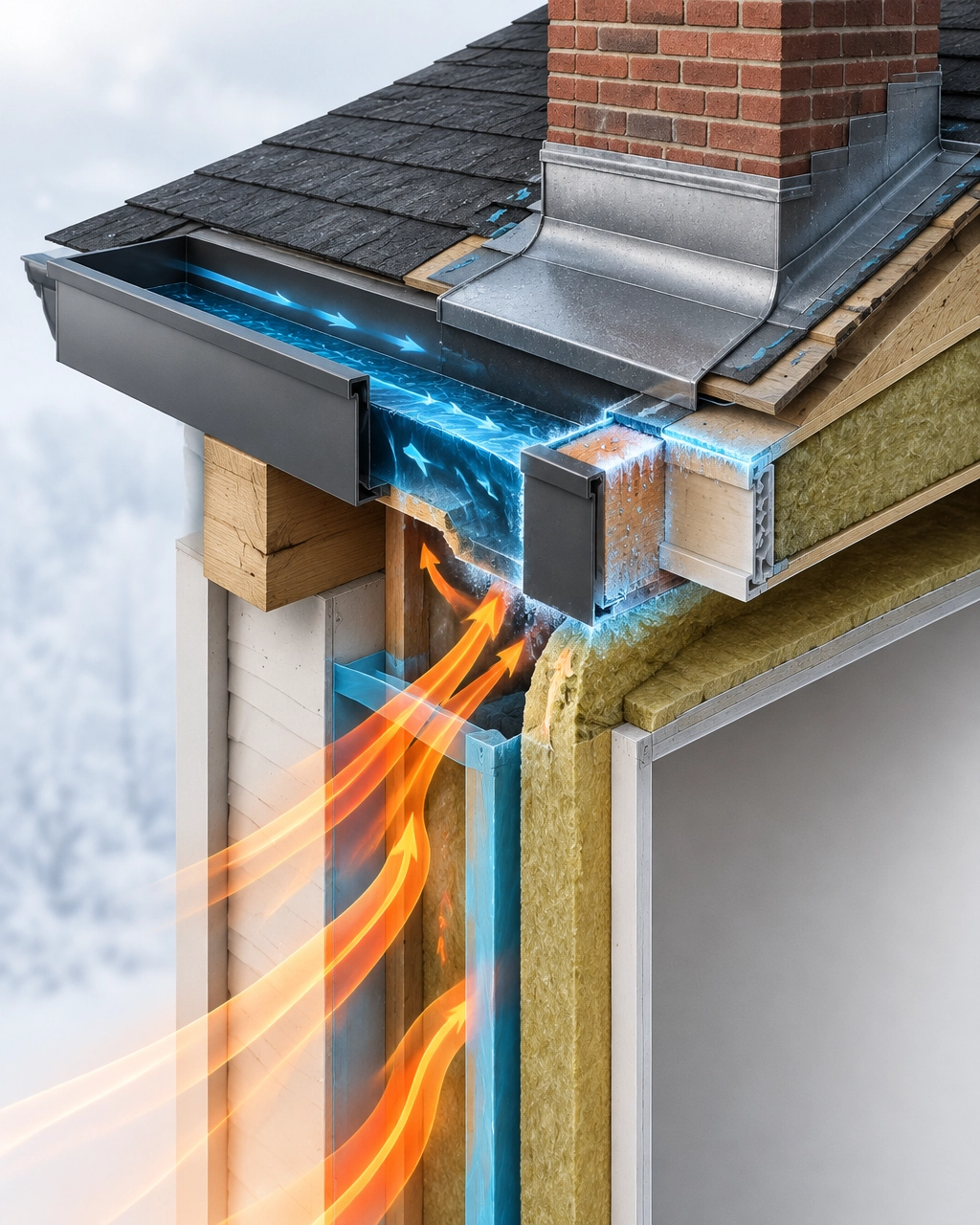
The critical distinction is between vapour diffusion and air transport. Diffusion through a material is measurable. Air leakage through a gap can carry a substantially greater moisture load because the moving air transports vapour directly into the assembly.
A membrane with excellent vapour resistance cannot compensate for an unsealed perimeter, a poorly detailed service penetration, or a discontinuity at a wall-to-roof junction.
The Site Execution Gap
The specification usually describes the membrane by brand, thickness, and permeability. The site needs a different level of control.
The project must define:
- Which face of the insulation the membrane belongs on.
- Whether the membrane is also the primary air barrier.
- How laps are formed and sealed.
- How corners and junctions are closed.
- How services pass through the control layer.
- How windows, doors, roofs, and floors connect to the same continuity line.
- Which inspection point occurs before the membrane is concealed.
- What evidence is retained for future audit or dispute analysis.
Without these controls, the membrane becomes a line on a drawing rather than a verified system.
This is where a construction consultant, home renovation consultant, or residential building consultant adds value. The role is not to substitute for design responsibility. It is to test whether design intent has survived procurement, sequencing, installation, inspection, and concealment.
For a client searching for a custom home build consultant Australia or construction advisory australia support, the same forensic principle applies globally: verify the control layer as an assembled system, not as an isolated product.
Standard Reference: Test Data Does Not Decide Location
International test standards establish material and assembly performance. They do not, by themselves, determine where a vapour control layer belongs.
ISO 12572 and ASTM E96
ISO 12572 determines water vapour transmission properties using the cup method. ASTM E96 provides a comparable framework for measuring water vapour transmission through materials and products.
These results help establish permeance and permeability. They are essential inputs, but they are not a substitute for climate analysis.
A low-permeance product may be appropriate on the warm, high-vapour-pressure side of an assembly. The same product may become a liability if placed on the wrong side or combined with another vapour-closed layer.
ASTM E2178
ASTM E2178 addresses air permeance of building materials. It helps determine whether a membrane, board, or sheathing product can contribute to an air-barrier strategy.
Material-level air permeance does not prove that the installed wall is airtight. The installation must still control joints, edges, interfaces, penetrations, and transitions.
ASTM E283 and AAMA Frameworks
ASTM E283 measures air leakage through exterior windows, doors, and curtain-wall assemblies under pressure difference. Relevant AAMA/FGIA fenestration testing frameworks use air-leakage performance criteria and interface testing principles.
These references are important because fenestration junctions are common points where the air barrier and vapour-control strategy lose continuity. A compliant window product does not guarantee a compliant wall interface.
The standards therefore establish a hierarchy:
- Use ISO 12572 or ASTM E96 to understand vapour transmission.
- Use ASTM E2178 to assess air permeance of materials.
- Use ASTM E283 and relevant AAMA/FGIA frameworks to assess fenestration air leakage.
- Use climate-specific hygrothermal analysis to determine position, drying potential, and condensation risk.
- Use site inspection to verify that the designed control layers actually exist.
Actionable Fix: Convert the Membrane Into a Controlled System
1. Define the Climate Driver
Document whether the assembly is primarily driven by heating, cooling, external humidity, seasonal reversal, or a combination of these conditions.
Do not transfer a standard wall detail between Dubai, Singapore, and the UK without reassessing vapour pressure, temperature gradients, solar exposure, internal humidity, and drying direction.
2. Mark the Control Layer Continuity Line
On every relevant plan and section, identify the intended air and vapour control layer. Continue that line through:
- Wall-to-roof junctions.
- Wall-to-floor junctions.
- Window and door interfaces.
- Internal and external corners.
- Structural transitions.
- Service penetrations.
- Renovation interfaces between new and existing work.
If the line cannot be traced without interruption, the design is not ready for construction.
3. Separate Product Approval From Installation Approval
Approve the product against the required permeability and air-permeance data. Then approve the installed system through inspection.
Check:
- Lap width and adhesion.
- Substrate cleanliness.
- Compatibility of tapes and sealants.
- Penetration seals.
- Corner treatment.
- Continuity behind services.
- Damage caused by subsequent trades.
- Connection to adjacent air-barrier components.
Photograph the work before concealment. Record locations, dates, products, and corrective actions.
4. Use Hygric Evidence, Not Assumption
Where the climate or assembly is complex, require a hygrothermal assessment. Consider seasonal vapour reversal, moisture storage, solar-driven drying, internal humidity, and the effect of low-permeance layers on both sides.
Do not rely on a single permeability number to predict whole-assembly performance.
5. Change the Audit Engagement Model
A final inspection after lining installation is a weak control. Engage at defined hold points:
- Before insulation conceals the control layer.
- After membrane installation and sealing.
- After services penetrate the membrane.
- Before internal or external linings close the assembly.
- During targeted opening-up if moisture evidence appears.
This converts inspection from a retrospective exercise into construction risk management services.
Shoal Bay Projects operates at this interface between specification, execution, evidence, and liability. Whether the appointment is made as a construction advisory review, a building dispute consultant engagement, or a pre-claim investigation, the objective is the same: identify whether physical construction supports the documented performance claim.
For further forensic construction intelligence, visit The Hive YouTube channel and explore Shoal Bay Projects.
⚠️ The image in this post is used for illustration purposes only, designed to encourage thoughtful discussion. It is not intended to represent a prescriptive detail of any installation or construction method.
Circle-Ready Companion
The Vapour Control Inversion: Why Membrane Position : Not Membrane Specification : Determines Moisture Performance Across Global Climates
A membrane can meet its permeability specification and still fail the building if it is installed on the wrong side of the insulation, interrupted at junctions, or treated as a product rather than a continuous control system.
This article examines the different moisture drivers affecting hot-humid locations such as Dubai and Singapore compared with temperate and cold environments such as the UK.
Key forensic takeaways:
- Vapour control position must respond to the dominant climate-driven vapour pressure, not simply the product data sheet.
- Air leakage through unsealed laps, penetrations, and junctions can transport more moisture than diffusion through the membrane itself.
- ASTM E96, ISO 12572, ASTM E2178, ASTM E283, and AAMA/FGIA frameworks provide performance evidence, but site verification is required to prove continuity.
Read the full article: The Vapour Control Inversion: Why Membrane Position : Not Membrane Specification : Determines Moisture Performance Across Global Climates
Image assets:
⚠️ The image in this post is used for illustration purposes only, designed to encourage thoughtful discussion. It is not intended to represent a prescriptive detail of any installation or construction method.
Claim Your Foundation Membership
The Vault. The App. The Community. We're opening the doors to a select group of Foundation Members : free, for a limited time. Foundation Membership includes full access to The Vault (our forensic intelligence archive) and early access to the Hive app.
Once the charter window closes, this tier is gone permanently. Foundation Members retain access for life. This is not a trial ; it's a permanent invitation to the founding cohort.
Claim Your Foundation Membership →