Problem: A Certified Screw Does Not Prove an Installed Connection
A fastener certificate is often treated as a proxy for connection quality.
The screw has a recognised grade. The product data sheet lists tensile and shear values. The supplier has provided batch documentation. The installation appears complete. On paper, the connection looks defensible.
That conclusion is frequently wrong.
In high-end residential construction, cold-formed steel screw connections are used in cladding brackets, furring channels, floor framing, roof members, balcony subframes and secondary support systems. These connections can be small, repetitive and visually unremarkable while carrying significant load and controlling movement, vibration, deflection and durability.
The forensic gap is between the fastener that was tested and the connection that was installed.
A certified screw establishes characteristics of the supplied fastener. It does not confirm:
- The actual thickness of the connected sheets.
- The effective thread engagement.
- The torque applied during installation.
- Whether the screw head or shoulder fully seated.
- Whether the receiving sheet threads were damaged.
- Whether the connection developed meaningful clamping force.
- Whether installation damage reduced the available capacity.
- Whether the installed connection resembles the tested configuration.
This distinction matters in Dubai, Singapore, the UK and every market where construction oversight must reconcile design intent with rapid site execution.
The installed connection is not a catalogue number. It is a system comprising the screw, connected sheet thicknesses, thread engagement, bearing surfaces, clamping force, geometry, installation method and verification record.
Forensic Analysis: Torque Is a Process Variable, Not a Certificate
The preload window
During installation, torque is consumed by several mechanisms:
- Drilling or penetrating the steel.
- Forming or cutting threads.
- Overcoming friction.
- Drawing the connected sheets together.
- Seating the head, washer or shoulder.
- Continuing to rotate after the connection is already seated.
Only part of the applied torque becomes useful axial clamping force.
This creates a narrow installation window:
Sufficient torque to achieve full seating and contact : but below the threshold that damages the threads, sheet or fastener.
Undertorque can leave a visible or concealed gap between the connected components. The screw may appear present while providing little clamping force. The assembly can move under service loading, allowing vibration, slip, fretting and progressive enlargement of the hole.
Overtorque creates a different failure path. The screw may continue rotating after the threads have stripped from the thin receiving sheet. The head may remain visually acceptable while the actual connection has lost its ability to develop reliable resistance.
A screw that spins freely after stripping is not “tight.” It is a failed installation.
Why torque does not automatically equal preload
For conventional bolted assemblies, torque–preload relationships can be characterised through controlled testing. However, cold-formed steel self-drilling and thread-forming screws introduce additional variables:
- Thin sheet has limited thread depth.
- Steel thickness can vary between nominal and actual values.
- Coatings alter friction.
- Drill-point geometry changes penetration resistance.
- Tool speed affects heat and thread formation.
- Surface contamination changes friction.
- Washer and bearing conditions change the torque distribution.
- The installer’s axial pressure can influence seating and penetration.
The result is that identical torque settings can produce different clamping forces across different sheet combinations and site conditions.
That is why a torque setting copied from a different bracket, screw diameter or sheet thickness should not be treated as universal evidence of compliance.
The correct question is not, “Was the screw the correct grade?”
Ask instead:
Did the installed screw develop the intended connection condition without damaging the thin steel or compromising the available limit states?
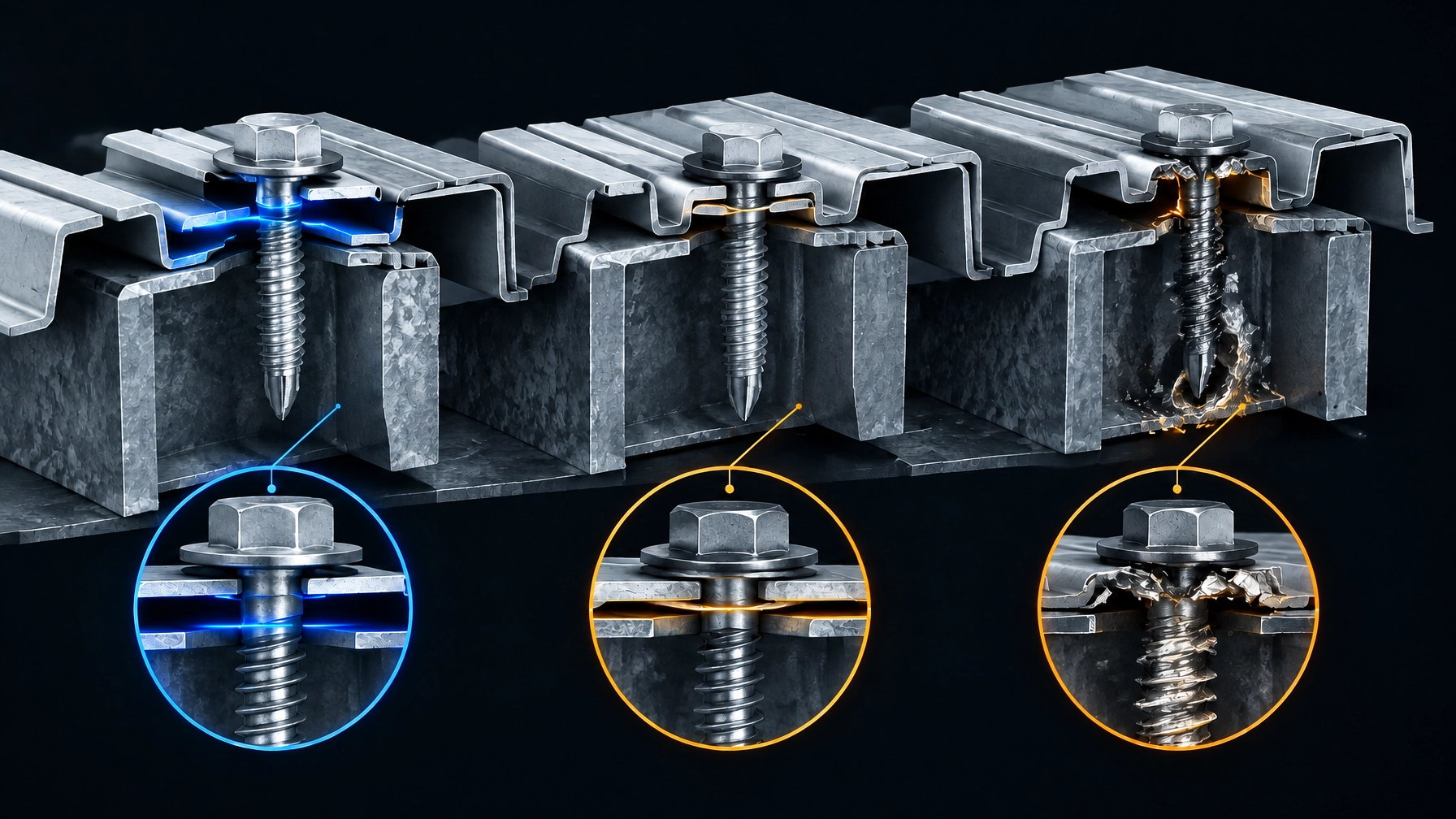
Separate the failure modes
A forensic review must distinguish installation damage from structural failure under load.
Thread stripping during installation
Thread stripping occurs when the installation process destroys the engagement between the screw and the receiving sheet. It is commonly associated with excessive torque, excessive tool speed, unsuitable tool settings or repeated driving.
The connection may show:
- A screw head that does not fully seat.
- A spinning screw.
- A damaged or enlarged hole.
- Metal swarf around the fastener.
- A screw that cannot be re-tightened.
- Local distortion of the bracket or sheet.
This is an installation defect. The original screw certificate cannot restore the damaged connection.
Pull-out under applied tension
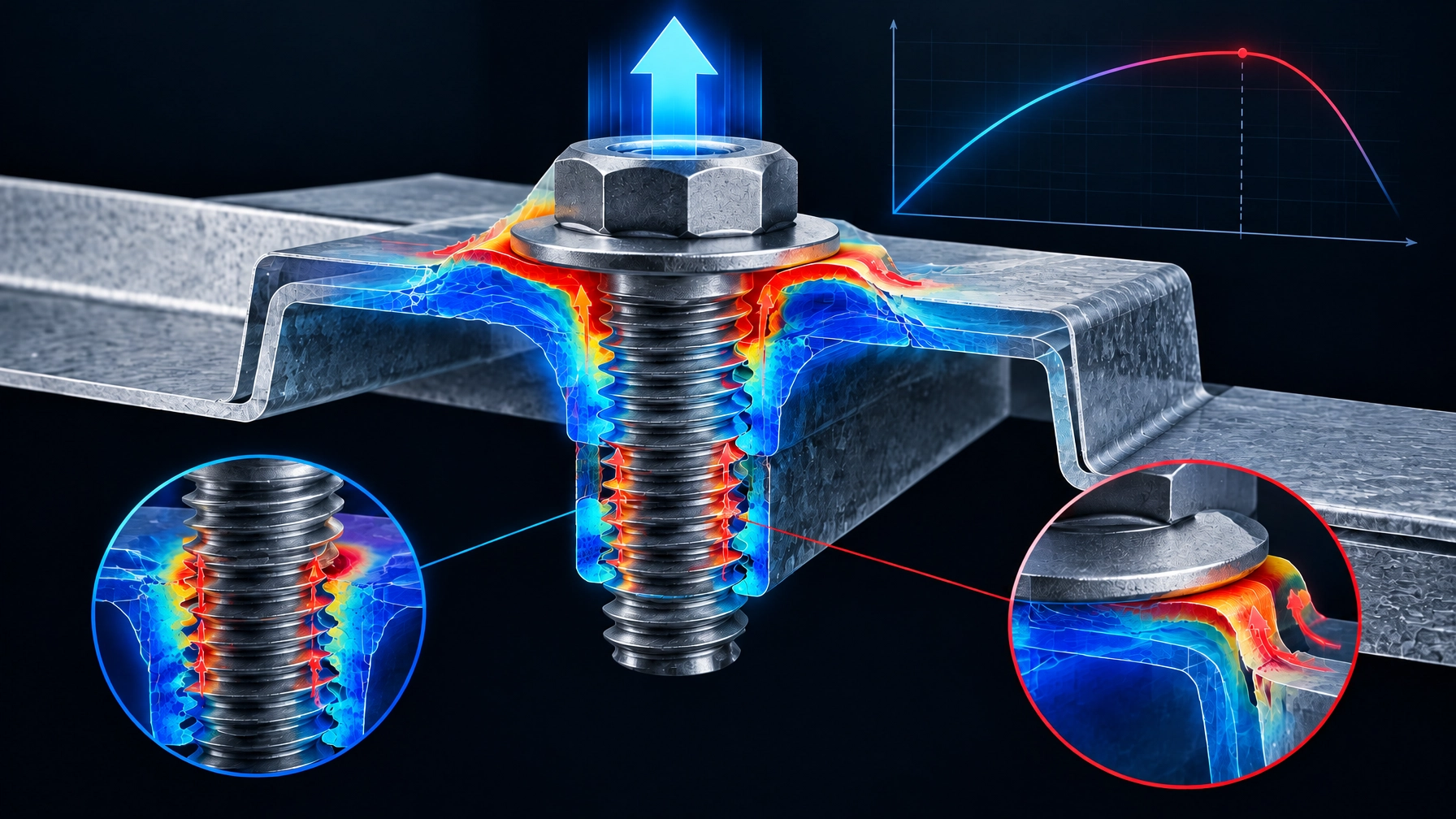
Pull-out is a load-induced failure in which the screw withdraws through the engaged sheet threads. The controlling variables include sheet thickness, material strength, screw diameter, thread engagement and applied load.
A connection can be correctly installed and still have inadequate pull-out resistance if the sheet is too thin, the load path is unsuitable or the design has not checked the relevant limit state.
Pull-over beneath the head or washer
Pull-over occurs when the sheet tears around the screw head or washer. It is governed by the thickness and strength of the sheet in contact with the bearing surface, together with the effective head or washer diameter.
Increasing screw grade does not automatically solve pull-over. The sheet beneath the head may remain the governing component.
Tilting, bearing and local tearing
Shear loading can produce screw tilting, bearing deformation or tearing at the edge of the sheet. These mechanisms become more sensitive where spacing, edge distance, eccentricity or connected thicknesses are poorly controlled.
The forensic error is to treat all visible screw failures as “fastener failures.” In many cases, the screw is stronger than the thin sheet surrounding it.
The finish-versus-performance conflict
High-end residential projects often impose demanding visual requirements. Brackets must appear aligned. Furring channels must present a clean plane. Cladding interfaces must be neat. Balcony subframes must avoid visible movement and irregularity.
Those requirements are legitimate, but appearance does not demonstrate structural performance.
A contractor may correct a proud screw because it looks untidy while overlooking a stripped screw that looks visually acceptable. An oversight body may review product documentation while missing an installation sequence that never developed adequate clamping force.
This is where a construction consultant or residential building consultant must bridge the gap between finish quality, engineering assumptions and construction compliance.
Audit Engagement: Why Timing Changes the Dispute
A desktop audit is efficient, but it is evidence-limited. It can review:
- Product certificates.
- Installation manuals.
- Drawings and schedules.
- Photographs.
- Inspection reports.
- Supplier declarations.
It cannot reliably prove the condition of concealed screw threads after installation.
A progressive audit captures evidence while the connection is still observable. It can record:
- The actual screw and sheet combination.
- Tool type and torque-control method.
- Installation sequence.
- Seating condition.
- Representative sample locations.
- Local damage or spin-outs.
- Connection details before concealment.
- Targeted verification testing where required.
This distinction changes dispute outcomes.
When a defect appears after cladding, lining or waterproofing has concealed the connection, the parties often argue from indirect evidence. The builder relies on certificates and completion photographs. The owner points to movement or damage. The designer relies on nominal connection capacity. The oversight body asks whether the installed work matches the approved detail.
Without progressive evidence, the dispute becomes a contest of assumptions.
A building dispute consultant should identify this evidentiary risk before the work is concealed. A construction risk management services program should treat installation verification as a planned control, not an optional inspection activity.

Standard Reference: What the International Standards Actually Establish
AISI S100: Design the connection, not only the fastener
AISI S100 addresses the design of cold-formed steel members and connections. For mechanically fastened connections, the relevant assessment must consider limit states such as:
- Pull-out.
- Pull-over.
- Bearing.
- Tilting.
- Tearing.
- Fastener fracture.
- Interaction between connected components.
The design capacity is therefore controlled by the weakest applicable mechanism, not automatically by the published strength of the screw.
AISI S100 is a design framework. It should not be misrepresented as a universal field torque specification for every self-drilling screw and sheet combination.
AISI S904: Test the screw
AISI S904 establishes methods for determining tensile and shear strengths of steel screws used with cold-formed steel sheet assemblies.
It is relevant to understanding the fastener as a tested component. It does not, by itself, validate the installed condition of a bracket, channel, floor member or roof assembly.
AISI S905: Test the connection
AISI S905 addresses the strength and deformation characteristics of cold-formed steel connections.
This connection-level perspective is essential. It recognises that the response of the assembly can be governed by sheet deformation, bearing, tearing, pull-over, pull-out or other connection behaviour rather than screw fracture alone.
ISO 16047: Useful framework, limited direct application
ISO 16047 provides a method for torque–clamp force testing of threaded fastener assemblies.
It is valuable for understanding the relationship between tightening torque, friction and clamp force. However, its stated scope excludes self-tapping and thread-forming fasteners. It should therefore not be used as direct proof that a field torque value has produced a known preload in a cold-formed steel self-drilling screw connection.
That limitation is itself an important forensic finding.
Use the standard that matches the connection and the evidence being claimed.
Actionable Fix: Build a Preload-Controlled Installation Record
1. Define the complete connection
Specify more than screw diameter and grade. Record:
- Screw type and manufacturer.
- Head, shoulder and washer geometry.
- Connected sheet thicknesses.
- Steel material properties.
- Required thread engagement.
- Edge distances and spacing.
- Installation tool and nose-piece arrangement.
- Approved installation sequence.
- Access and concealment constraints.
2. Establish the installation window
Obtain manufacturer instructions for the exact screw and connected material. Do not transfer torque values from a different assembly without technical justification.
Control:
- Tool speed.
- Axial pressure.
- Torque or depth settings.
- Bit condition.
- Screw alignment.
- Seating condition.
- Replacement procedure for damaged installations.
3. Verify representative installations
Use a calibrated tool and document the installation process. Where the connection is safety-critical or dispute-sensitive, perform representative verification using an agreed test method or connection-level assessment.
Do not rely on a single photograph of a screw head as evidence of preload.
4. Inspect before concealment
Progressive inspection should occur before cladding, lining, membranes or finishes prevent access.
Record representative locations, not only the easiest locations. Photograph the connected sheets, screw seating and any local deformation. Identify and replace stripped or spinning screws rather than attempting to conceal them.
5. Preserve the evidence chain
Maintain a connection register linking:
- Location.
- Detail reference.
- Screw batch.
- Sheet thickness.
- Installer or crew.
- Tool setting.
- Inspection date.
- Defects identified.
- Corrective action.
- Verification evidence.
This converts an informal installation activity into a defensible construction compliance record.
6. Engage forensic advisory support early
Shoal Bay Projects provides building consultancy services focused on construction planning, compliance interpretation, quality expectations and construction risk management. The objective is not to create paperwork after failure. It is to identify the physical and evidentiary gaps before they become a defect claim, delay event or legal dispute.
For further technical discussion, visit the Shoal Bay Projects Hive YouTube channel.
The central conclusion is simple:
A screw certificate describes the fastener. Installation discipline determines the connection.
⚠️ The image in this post is used for illustration purposes only, designed to encourage thoughtful discussion. It is not intended to represent a prescriptive detail of any installation or construction method.
Claim Your Foundation Membership
The Vault. The App. The Community. We're opening the doors to a select group of Foundation Members : free, for a limited time. Foundation Membership includes full access to The Vault (our forensic intelligence archive) and early access to the Hive app.
Once the charter window closes, this tier is gone permanently. Foundation Members retain access for life. This is not a trial : it's a permanent invitation to the founding cohort.
Claim Your Foundation Membership →
Circle-Ready Pack
Community Introduction
A certified screw is not the same thing as a verified connection.
This post examines the forensic gap between fastener documentation and installed preload in cold-formed steel connections. The critical issue is not simply whether the screw has the correct grade. It is whether the complete assembly : screw, sheets, thread engagement, seating condition and installation process : developed the intended performance without stripping or damaging the thin steel.
Read the full article: The Torque Mirage: Why Installation Preload : Not Screw Grade : Determines Cold-Formed Steel Connection Performance in High-End Residential Construction
Full company link: Shoal Bay Projects
Key Forensic Takeaways
- A fastener certificate proves characteristics of the supplied screw. It does not prove installed clamping force, thread engagement or connection capacity.
- Undertorque can leave a loose connection; overtorque can strip the receiving sheet and create a concealed installation failure.
- Progressive audits capture evidence that desktop reviews cannot, particularly before cladding, lining or membranes conceal the connection.
- AISI S100 assesses connection limit states; AISI S904 addresses screw testing; AISI S905 addresses connection strength and deformation.
- ISO 16047 is useful for torque–clamp force testing, but its scope excludes self-tapping and thread-forming fasteners.
Image Assets
⚠️ The image in this post is used for illustration purposes only, designed to encourage thoughtful discussion. It is not intended to represent a prescriptive detail of any installation or construction method.
Claim Your Foundation Membership
The Vault. The App. The Community. We're opening the doors to a select group of Foundation Members : free, for a limited time. Foundation Membership includes full access to The Vault (our forensic intelligence archive) and early access to the Hive app.
Once the charter window closes, this tier is gone permanently. Foundation Members retain access for life. This is not a trial ; it's a permanent invitation to the founding cohort.
Claim Your Foundation Membership →