Construction
Jul 2, 2026
The Systemic Failure Cascade: Why Vapour Barriers Are the Silent Asset Killers
The Systemic Failure Cascade: Why Vapour Barriers Are the Silent Asset Killers

The Systemic Failure Cascade: Why Vapour Barriers Are the Silent Asset Killers
In the world of high-end residential construction, we often focus on the visible. We obsess over the grain of the European oak flooring, the precision of the mitred stone edges, and the seamless integration of smart home technology. But for a building consultant, the most critical components are the ones you will never see once the plasterboard is fixed.
Among these hidden elements, the vapour barrier (or pliable building membrane) is perhaps the most misunderstood and poorly executed. When specified or installed incorrectly, it becomes the catalyst for a Systemic Failure Cascade: a sequence of structural and environmental degradation that can devalue a multi-million dollar asset in less than a decade.
At Shoal Bay Projects, we approach these failures forensically. We don't just look at the damage; we look at the physics that allowed it to happen.
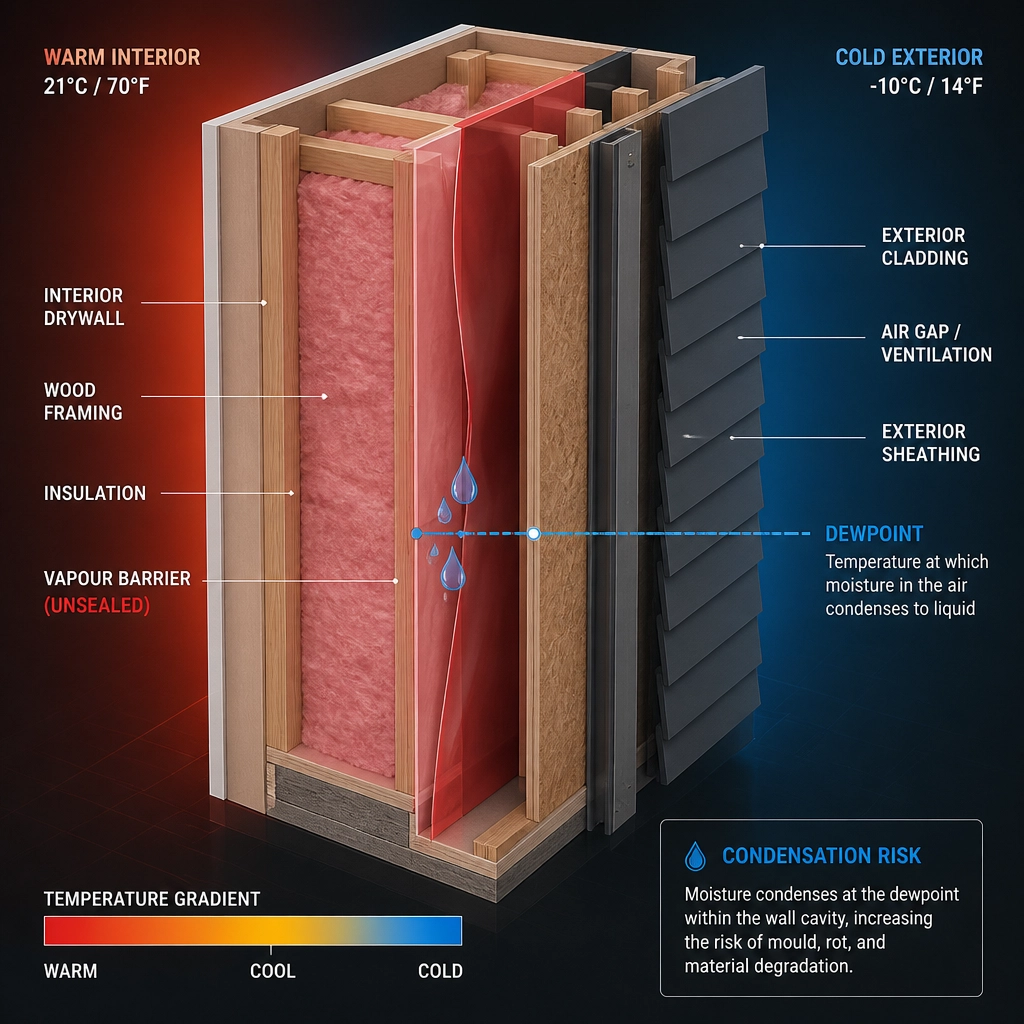
To understand why a thin layer of foil or plastic can kill an asset, you have to understand the Dewpoint.
The dewpoint is the temperature at which air can no longer hold its water vapour, causing it to condense into liquid water. In a standard Australian home, the interior air is often warm and laden with moisture (from cooking, breathing, and showering). Outside, especially in southern climate zones or during winter nights, the air is significantly colder.
As that warm, moist air moves through your wall assembly: driven by pressure differentials: it eventually hits a surface cold enough to trigger condensation. If that surface is a non-permeable vapour barrier positioned on the wrong side of the insulation, you have essentially created a rain machine inside your walls. This is known as interstitial condensation.
Physics doesn't negotiate. If the temperature gradient meets the dewpoint inside your wall cavity, water will form. The question is: where does that water go?
The installation of pliable building membranes is governed by AS 4200.2: Pliable building membranes and underlays – Installation. This standard is often treated as a "suggestion" on site, but its requirements are clinical for a reason.
A common misconception is that moisture moves through walls primarily via vapour diffusion: slowly seeping through materials. In reality, air leakage is the primary driver. Air movement through unsealed gaps and penetrations can carry orders of magnitude more moisture into a wall cavity than diffusion ever could.
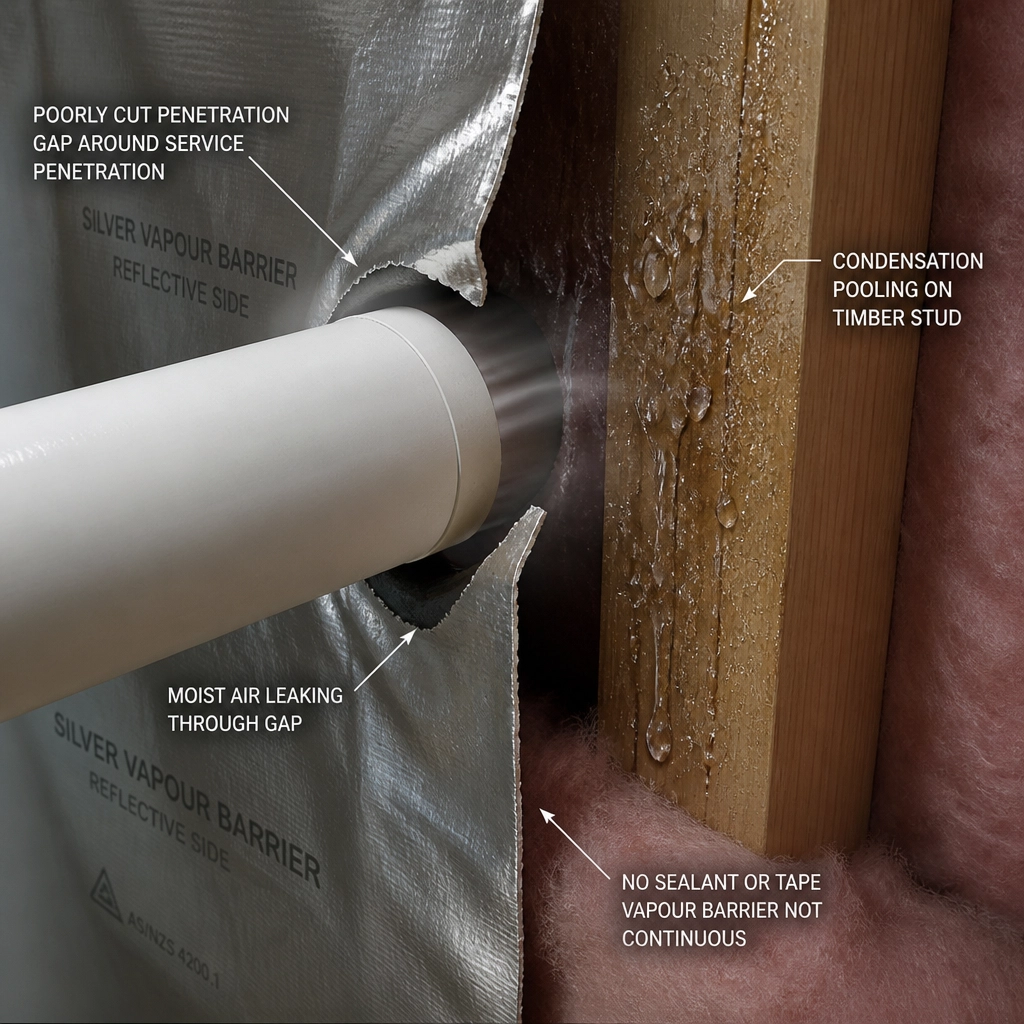
A systemic failure doesn't happen all at once. It is a slow, silent cascade that follows a predictable path:
Once interstitial condensation forms, it saturates the insulation and the paper face of the internal gypsum linings. This creates the perfect petri dish. Mould begins to thrive in the dark, damp cavity. Because it is hidden, the occupants are often unaware until they begin experiencing respiratory issues or a persistent "musty" smell that no amount of cleaning can fix.
As the moisture remains trapped against the timber framing (often due to a lack of a drained cavity or a non-permeable wrap), the timber reaches a fibre saturation point. At this stage, fungal decay sets in. Studs lose their structural integrity, and fixings begin to corrode. In a high-end build with heavy stone or timber cladding, the sub-structure may be rotting away while the exterior remains pristine.
Mould spores and mycotoxins don't stay in the wall. Through pressure changes (stack effect), these contaminants are drawn into the living spaces. For a homeowner, this turns a sanctuary into a health hazard.
When the failure is finally discovered: often through visible staining, swelling of claddings, or structural sag: the rectification costs are astronomical. You aren't just replacing a membrane; you are stripping the cladding, replacing structural timber, discarding saturated insulation, and remediating mould. For a high-end asset, this is a catastrophic financial hit.
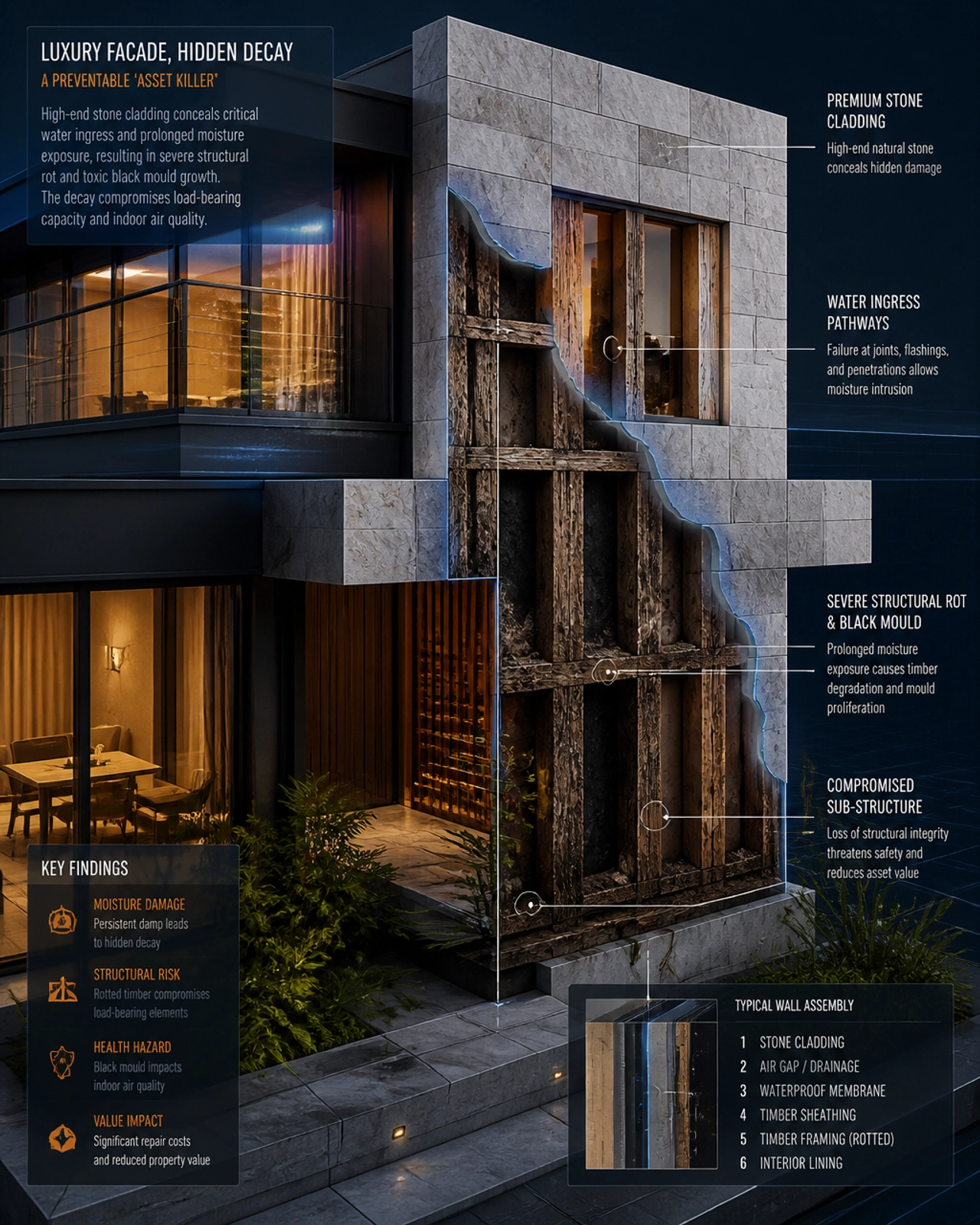
The National Construction Code (NCC) 2022 has introduced significantly more robust provisions for Condensation Management (Part 10.8). These aren't just technicalities; they are legal requirements designed to stop the systemic failure cascade.
Why does Shoal Bay Projects focus so heavily on these technical details? Because by the time you see the mould, the cascade is already in its final stages.
Our role is to provide structured, compliance-focused advisory before the first stud is even standing. We help builders and homeowners navigate the complexities of AS 4200.2 and NCC Part 10.8 to ensure that the "invisible" layers of the home are as high-performance as the visible ones.
Check your specifications. Specify the correct membrane class. Document your penetration sealing. These small, imperative steps are the only way to protect a residential asset from the silent killer that is interstitial condensation.
Construction is a team sport, and staying ahead of regulatory shifts like the NCC 2022 condensation provisions requires constant learning. We invite you to join our community hub to explore more deep-dives into building science, compliance, and risk management.
Explore the Community Hub: Welcome to the Hive