“We passed the moisture test” is one of the most expensive sentences in high-end residential construction.
It sounds definitive. It is often not.
A concrete slab is not simply “dry” or “wet”. Its moisture condition is quantified through a specific test method, at a specific depth, under specific environmental conditions, using calibrated equipment and a documented sampling plan.
When those controls are absent, the result is not defensible evidence. It is an opinion recorded at a convenient moment.
Problem
Flooring failures frequently emerge between six and twenty-four months after handover. By then, the slab is concealed, the installer’s access is gone, and the original test record may consist of a single certificate stating “pass”.
The visible symptoms may include:
- Debonding or adhesive failure
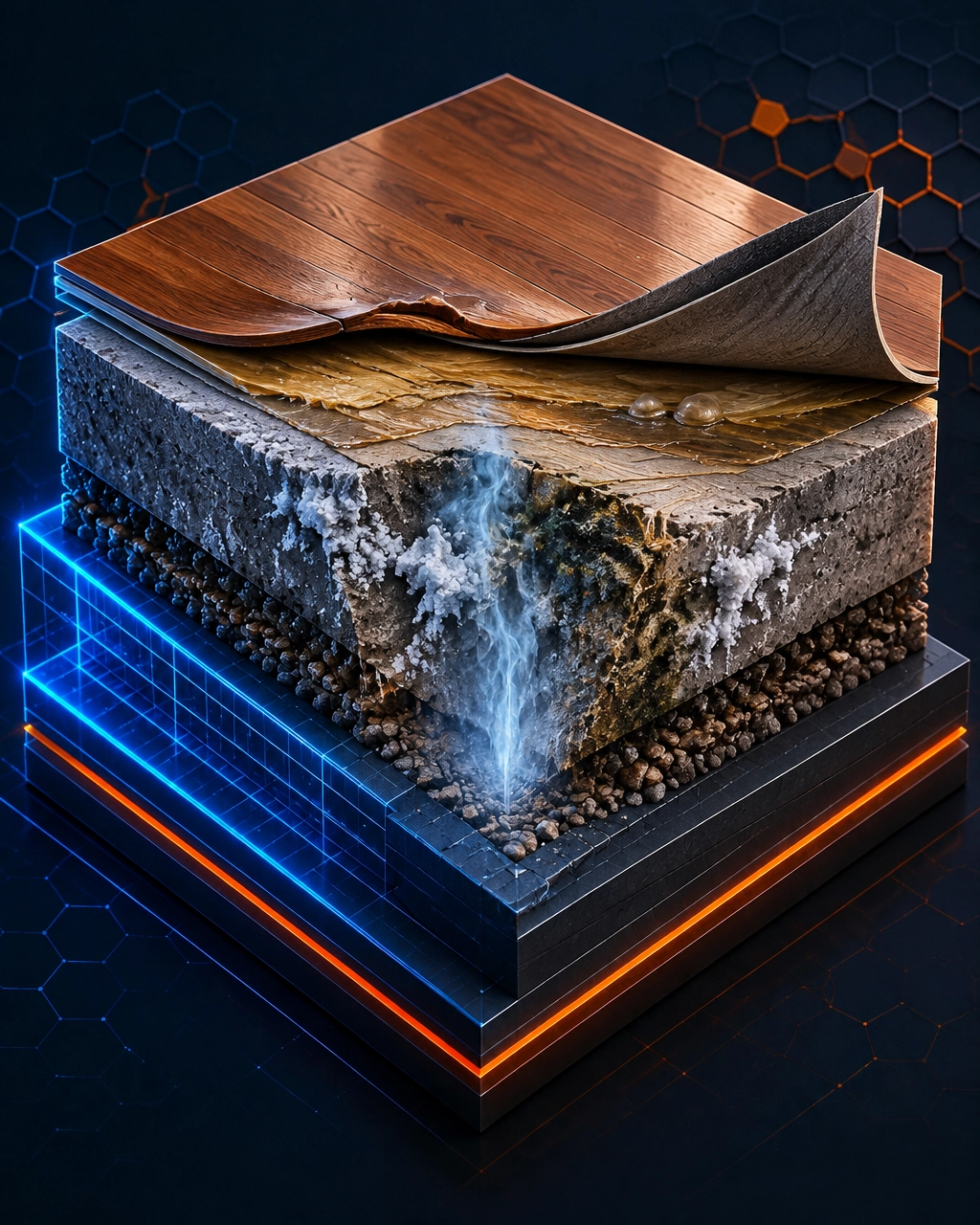
- Blistering beneath resilient flooring
- Timber cupping, crowning or edge distortion
- Efflorescence at joints and perimeter zones
- Mildew or microbial growth beneath impermeable finishes
- Adhesive shear creep
- Localised lifting where moisture has continued migrating from the slab core
The failure is then treated as a flooring defect, an adhesive defect or an isolated workmanship issue. The causal condition may have been established before the floor was ever installed: the slab was tested using the wrong method, at the wrong depth, before the building reached service condition, or with insufficient test locations.
This problem is global. A luxury residence in Dubai, a custom home in Singapore and a high-value refurbishment in the UK may use different contractors, climatic controls and contractual structures. The forensic weakness is the same: programme pressure rewards installation, while the owner requires a defensible performance record.
Forensic Analysis
1. F2170 and F1869 are not interchangeable
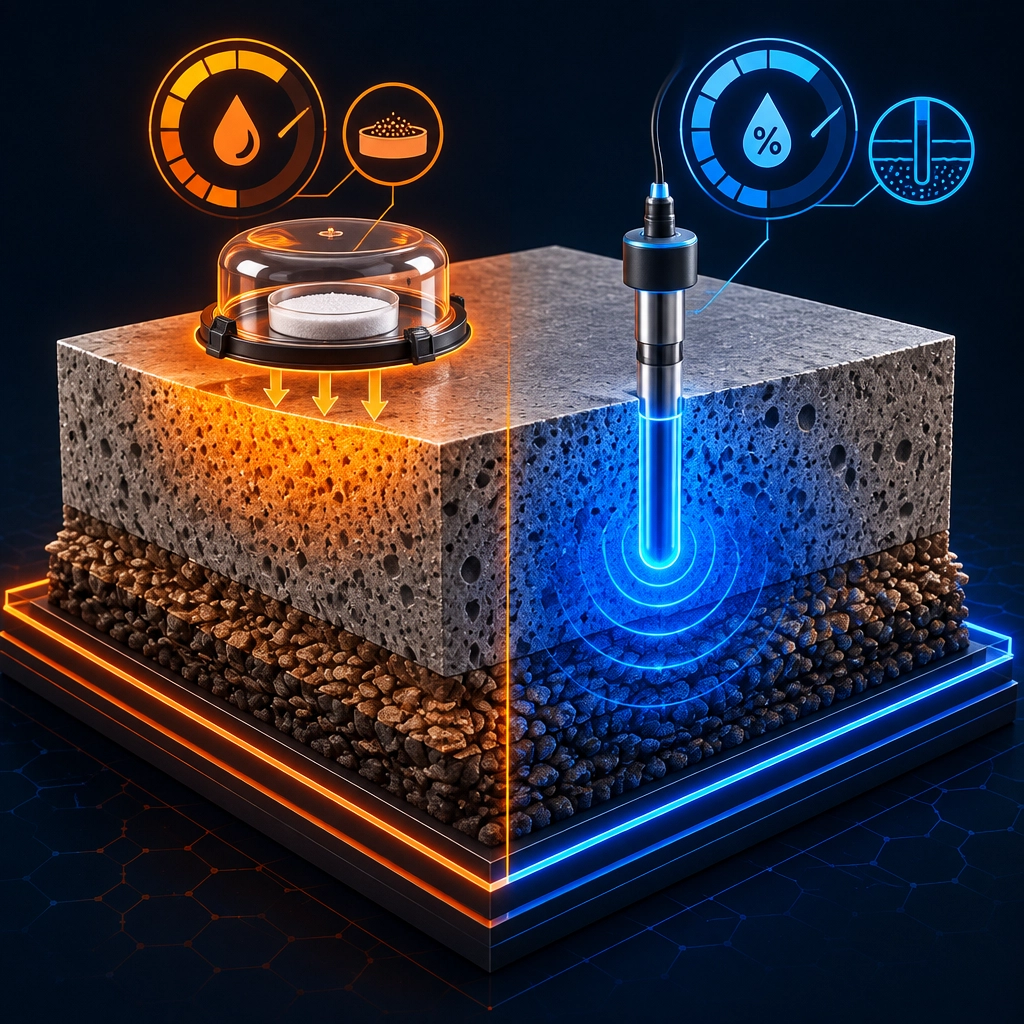
ASTM F2170 measures in-situ relative humidity inside the concrete slab using a probe installed at a defined internal depth.
ASTM F1869 measures moisture vapour emission rate, or MVER, from the slab surface using anhydrous calcium chloride. The result is expressed as pounds of water per 1,000 square feet per 24 hours.
These are different physical quantities measured in different locations.
An ASTM F1869 surface result cannot be substituted for an ASTM F2170 internal relative-humidity requirement. The reverse is equally invalid. The results are not interchangeable and should not be treated as equivalent pass/fail evidence unless the flooring and adhesive manufacturer has expressly defined that method as acceptable.
A surface can appear dry while the slab core remains moisture-loaded. Conversely, a surface emission result can be influenced by the immediate environment in ways that do not represent the long-term internal moisture condition.
The test method is therefore part of the requirement. It is not an administrative detail.
2. Probe depth and hole conditioning control the result
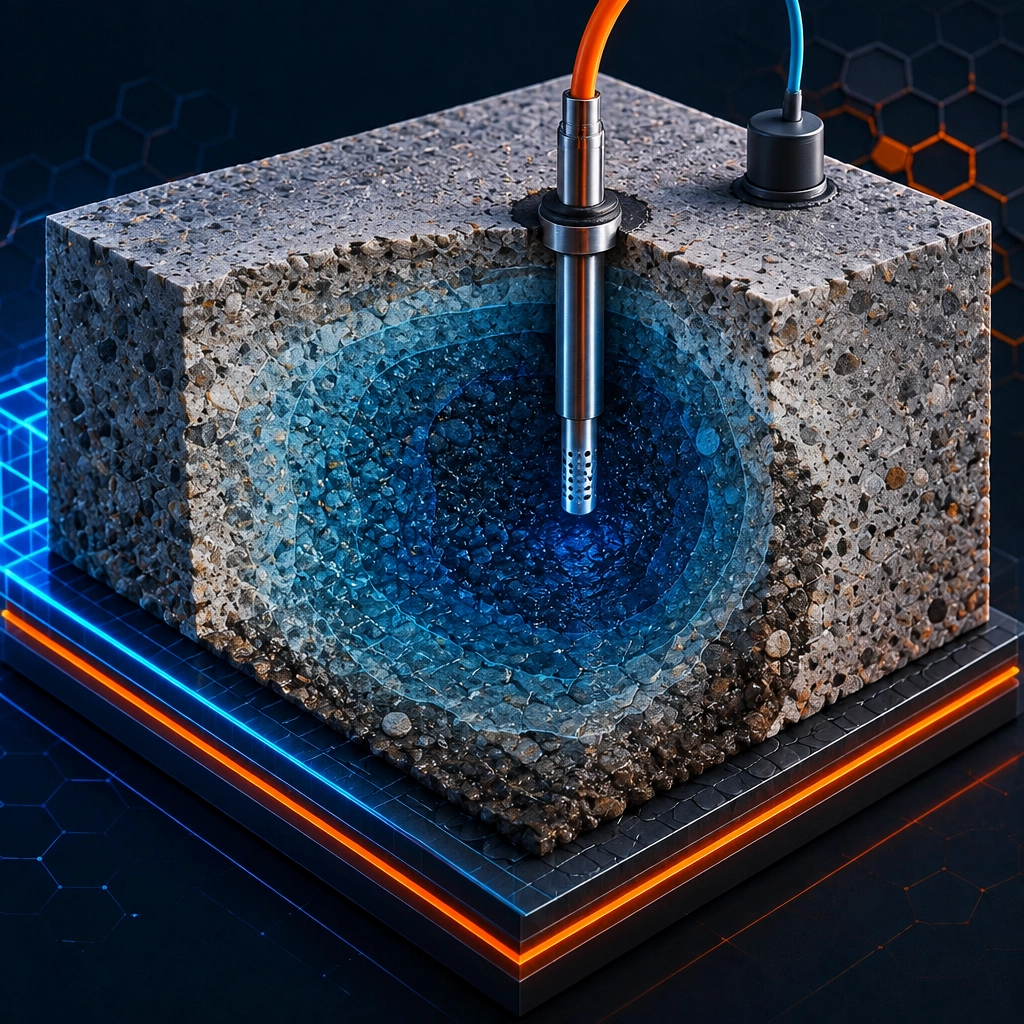
Under ASTM F2170, probe depth is determined by the slab’s drying direction.
For a slab drying from one side, such as a typical slab-on-ground construction, the probe is generally located at approximately 40% of slab thickness. For a slab drying from two sides, such as an elevated slab with no effective vapour retarder below, the relevant depth is generally approximately 20%.
A probe installed too shallow can measure a relatively dry zone near the surface while missing the moisture reservoir beneath it.
The hole must also be correctly formed, conditioned and sealed. Common forensic departures include:
- Drilling without verifying the actual slab thickness
- Installing the probe at an assumed rather than measured depth
- Leaving the test hole open to ambient air
- Failing to allow the probe and surrounding concrete to equilibrate
- Taking readings before the required minimum equilibration period
- Using instruments without current calibration records
- Placing tests only in convenient or visibly dry locations
Test quantity and distribution matter. A nominal minimum of three locations for the first 1,000 square feet, with additional locations for each further 1,000 square feet, is not a substitute for engineering judgement. Large floor areas, variable slab thickness, different exposure conditions, penetrations, joints, perimeter zones and areas with different drying histories may require a more rigorous distribution.
A small number of conveniently located tests can create a false impression of uniformity.
3. Ambient conditioning can conceal the slab’s actual service behaviour
Moisture readings taken before the building reaches intended service condition are vulnerable to misinterpretation.
ASTM F2170 testing requires the environment to be enclosed and conditioned to representative service temperature and relative humidity before testing. The purpose is not cosmetic comfort. It is to establish an environment in which moisture movement within the slab can be meaningfully evaluated.
If the building has been rapidly heated, mechanically dried or temporarily ventilated immediately before installation, the surface may respond faster than the slab core. The result can be a dry-looking surface over a moisture-loaded interior.
This is particularly relevant where:
- The HVAC system has not operated continuously
- Doors and windows have remained open during testing
- Temporary dehumidification has been used without a documented conditioning history
- The slab has been exposed to rain or wash-down water
- Testing occurs immediately before flooring installation
- There is no record of temperature and ambient relative humidity before and during testing
A single-day reading cannot reconstruct the slab’s moisture history.
4. The manufacturer’s threshold is a warranty gate
Flooring and adhesive manufacturers may publish limits such as 75–85% internal relative humidity or 3–5 pounds per 1,000 square feet per 24 hours MVER. These values are product-specific.
They are not universal definitions of a compliant slab.
ASTM F710 provides practice for preparing concrete floors to receive resilient flooring. It addresses conditions including cleanliness, smoothness, structural soundness and moisture evaluation. It does not create a universal moisture limit for every flooring or adhesive system.
The published manufacturer requirement controls the warranty pathway. However, the certificate has value only if the test method, depth, ambient condition, location count and instrument records align with that requirement.
A generic “moisture pass” statement, unsupported by the product specification, is commercially weak and forensically vulnerable.
5. Programme compression destroys the evidence trail
The most common failure pattern is predictable:
- Flooring installation is programmed before the slab reaches the required condition.
- Testing is delayed until the installation date is imminent.
- A limited number of readings are taken.
- The result is recorded without a method statement, conditioning history or site plan.
- Installation proceeds because delay carries a commercial cost.
- A failure develops after handover.
- The original slab condition is permanently concealed beneath the finished floor.
This is not merely a technical failure. It is a governance failure.
The contractor and installer may be incentivised to proceed. The owner requires evidence that the floor system was ready to receive the finish. Those interests are not automatically aligned.
Audit engagement models determine whether the conflict is exposed or concealed. A single-visit sign-off tends to record a moment. Progressive, independent verification records a process.
Standard Reference
The following international references define the relevant technical framework:
- ASTM F2170, in-situ relative humidity measurement inside concrete slabs.
- ASTM F1869: surface moisture vapour emission rate using anhydrous calcium chloride.
- ASTM F710: preparation and acceptability of concrete floors before resilient flooring installation.
- ASTM E96: water vapour transmission through materials and assemblies.
- ISO 12572: hygrometric determination of water vapour permeability and vapour resistance of building products.
- ACI 302.1R: construction guidance for concrete floor slabs, including curing, finishing and moisture-sensitive flooring considerations.
- ACI 360R: design guidance for slabs-on-ground, including subgrade, slab configuration, joints and moisture-related design coordination.
- ASTM C309: performance requirements for liquid membrane-forming curing compounds. Compliance with ASTM C309 does not automatically establish compatibility with later flooring adhesives or finishes.
The standards must be read as a coordinated system. ASTM E96 and ISO 12572 quantify vapour transmission through materials; they do not by themselves certify that a finished slab is ready for flooring. ACI 302.1R and ACI 360R address construction and design decisions that influence drying and long-term behaviour. ASTM F2170, F1869 and F710 address the pre-installation assessment and preparation process.
No single document replaces the evidence chain.
Actionable Fix
Build a controlled moisture evidence chain
Before flooring installation commences:
- Identify the flooring and adhesive system. Record the manufacturer’s required test method and maximum values.
- Issue a method statement. Define the applicable standard, equipment, calibration status, test depth, locations, conditioning period and reporting format.
- Verify slab geometry. Confirm slab thickness and whether drying occurs from one side or two sides.
- Select representative locations. Include perimeter zones, large open areas, areas with different exposure histories and locations affected by penetrations or geometry changes.
- Condition the building. Stabilise temperature and ambient relative humidity at intended service conditions before testing.
- Install and seal probes correctly. Allow the required equilibration period before taking readings.
- Record every location. Retain a marked plan, photographs, serial numbers, calibration records, environmental data and test results.
- Do not substitute methods. Treat F2170 RH and F1869 MVER as separate measurements with separate acceptance criteria.
- Define remediation in advance. Specify approved drying, surface preparation or moisture mitigation measures where results exceed the manufacturer’s limit.
- Re-test after remediation. Do not release the floor for installation based on a verbal confirmation or an unverified certificate.
- Retain the record through handover. Preserve the complete evidence trail with the project quality documentation.
The governing principle is simple: a single-day result with no method statement is an opinion, not evidence.
Shoal Bay Projects operates as the forensic advisory bridge between physical site execution, manufacturer requirements and defensible project governance. Independent progressive verification can identify the moisture risk before it becomes a concealed flooring failure, warranty dispute or legal claim.
For further construction intelligence, visit the Shoal Bay Projects Hive YouTube channel.
⚠️ The image in this post is used for illustration purposes only, designed to encourage thoughtful discussion. It is not intended to represent a prescriptive detail of any installation or construction method.
Claim Your Foundation Membership
The Vault. The App. The Community. We're opening the doors to a select group of Foundation Members. Free, for a limited time. Foundation Membership includes full access to The Vault (our forensic intelligence archive) and early access to the Hive app.
Once the charter window closes, this tier is gone permanently. Foundation Members retain access for life. This is not a trial: it's a permanent invitation to the founding cohort.
Claim Your Foundation Membership →
Circle-Ready Companion
The Substrate Moisture Illusion: Why Test Method Replaceability and Ambient Conditioning Invalidate Slab Moisture Readings Before Flooring Installation
“We passed the moisture test” is often treated as the end of the discussion. In forensic review, it is usually the beginning.
This article examines why concrete slab moisture must be treated as a controlled evidence chain rather than a one-day installation certificate. The central issue is simple: ASTM F2170 and ASTM F1869 measure different physical quantities at different locations. One cannot be substituted for the other.
Blog link: Shoal Bay Projects
Key forensic takeaways
- Do not substitute test methods. ASTM F2170 measures internal slab relative humidity. ASTM F1869 measures surface moisture vapour emission rate. They are not interchangeable.
- Control depth and conditioning. Probe depth, sealed holes, equilibration time, slab drying direction and ambient service conditions directly affect the reliability of the result.
- Treat the certificate as evidence only when the chain is complete. Record the manufacturer’s threshold, calibration, test locations, environmental history, remediation and re-test protocol.
Image assets
For ongoing construction intelligence, join the Hive YouTube channel.
⚠️ The image in this post is used for illustration purposes only, designed to encourage thoughtful discussion. It is not intended to represent a prescriptive detail of any installation or construction method.
Claim Your Foundation Membership
The Vault. The App. The Community. We're opening the doors to a select group of Foundation Members. Free, for a limited time. Foundation Membership includes full access to The Vault (our forensic intelligence archive) and early access to the Hive app.
Once the charter window closes, this tier is gone permanently. Foundation Members retain access for life. This is not a trial: it's a permanent invitation to the founding cohort.
Claim Your Foundation Membership →