Part 3 of the five-part Dubai Construction Advisory, Compliance & Forensic Investigation series.
Dubai construction projects frequently rely on a mobile plant market. Excavators, telehandlers, concrete pumps, placing booms, tower cranes, mobile cranes, piling rigs, generators and compaction equipment may be owner-operated, sub-hired or supplied with an operator attached to the machine.
That arrangement is commercially efficient. It is also a significant control risk.
When the contractor hires the machine and the operator as a combined package, responsibility for method, competence, maintenance and performance can become blurred. A machine may arrive on site operational, accompanied by a valid inspection record and an experienced operator. None of those facts proves that the plant can hold the required construction tolerance under the specific project conditions.
The forensic question is not simply, “Was the machine working?”
Ask a more precise question:
Could this operator, using this machine, in this condition, with this setup, repeatedly achieve the specified result?
Problem: The machine is operational, but the work is out of tolerance
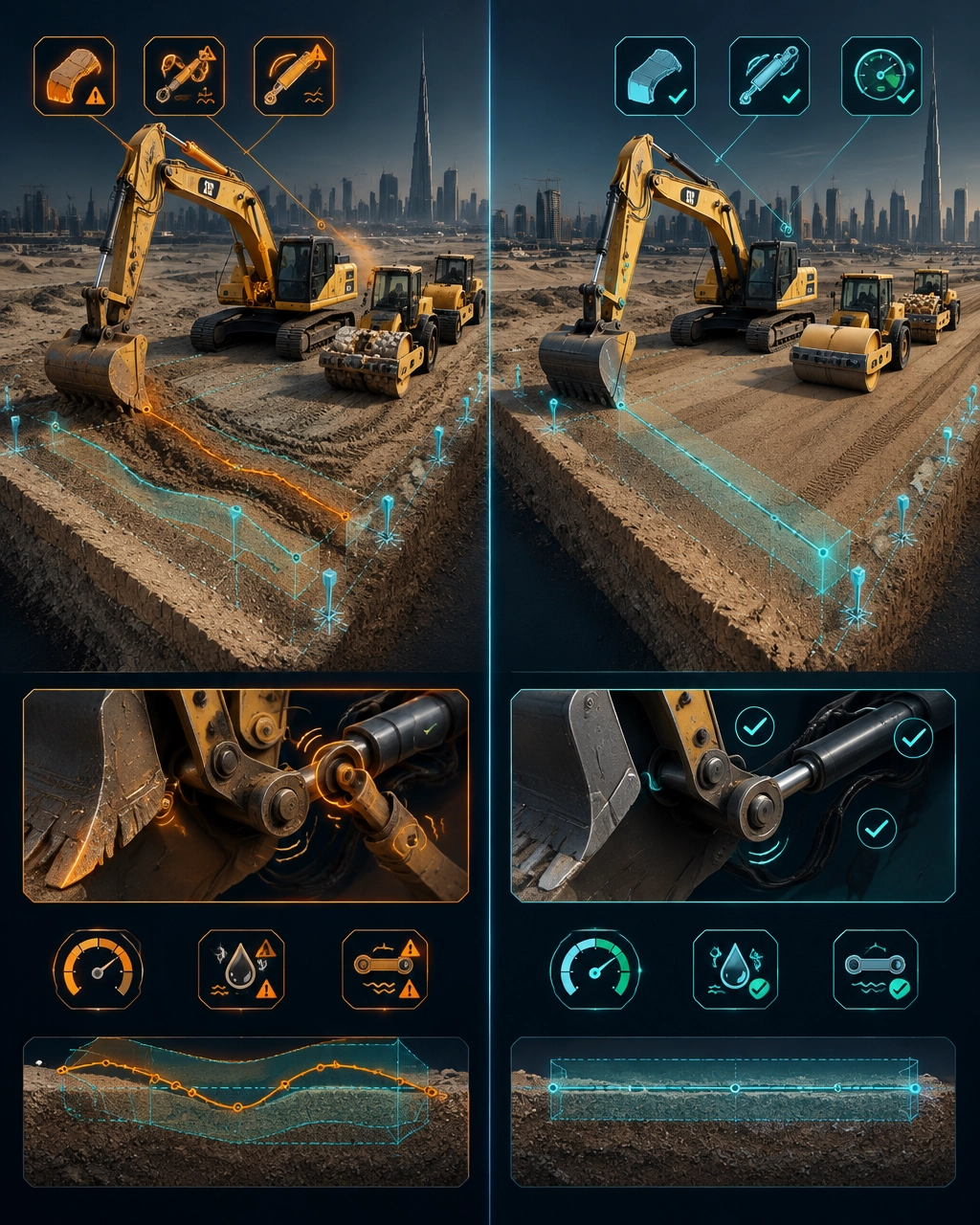
A machine can start, move, lift, pump or compact and still be incapable of producing compliant work.
This distinction is routinely missed during site audits. Plant is checked for visible damage. An operator presents a licence or competency card. The work proceeds. When the finished result falls outside tolerance, the issue is assigned to “poor workmanship”.
That conclusion is often premature.
On Dubai projects, plant is commonly sourced through hire companies, labour suppliers and specialist subcontractors. The operator may have been selected by the equipment owner rather than the principal contractor. The contractor may control the programme and output but have limited control over:
- The operator’s actual experience with the specific machine configuration.
- The machine’s maintenance history.
- The condition of hydraulic, control and safety systems.
- Calibration of grade, pressure, flow or load-monitoring equipment.
- Previous repairs, including the use of non-genuine replacement parts.
- Whether the operator’s certification applies to the machine class, capacity and configuration in use.
This creates two separate but connected failure vectors:
- Operator technique: the human variable.
- Machine condition and calibration: the mechanical variable.
Both can produce the same visible outcome: dimensional deviation, uneven compaction, poor concrete placement, damaged finishes, unstable lifting or rework.
Forensic Analysis: Separate the human variable from the mechanical variable
1. Operator technique changes the result
Machine controls and guidance systems do not eliminate operator influence. They reduce uncertainty only when the system is correctly set up and competently used.
For earthworks, grading and formation preparation, operator technique affects:
- Bucket angle and cutting sequence.
- Speed of excavation and trimming.
- Control of hydraulic functions.
- Response to survey points and grade guidance.
- Recognition of changing ground conditions.
- Consistency between passes.
- Final trimming and compaction coordination.
An excavator operator can produce a visually acceptable platform that varies materially across the site. A telehandler operator can place materials within a general area while introducing repeated impact, instability or damage. A compactor operator can complete the required number of passes without achieving uniform density because the sequence, speed or moisture condition was not controlled.
For concrete placement, pump operator technique influences:
- Pumping rate.
- Delivery continuity.
- Placement sequence.
- Hose and boom movement.
- Coordination with vibration and finishing crews.
- Response to blockages, pressure fluctuations and interruptions.
A pump can be fully operational while poor placement control increases segregation, creates cold-joint risk or overloads the receiving formwork.
For lifting operations, crane operator proficiency determines whether a lift is smooth or shock-loaded. Rapid hoisting, abrupt slewing, uncontrolled trolley movement and poor coordination with the signalperson can generate dynamic effects that are not visible in a basic pre-start inspection.
2. Machine condition changes the tolerance envelope
The second failure vector is the condition of the plant itself.
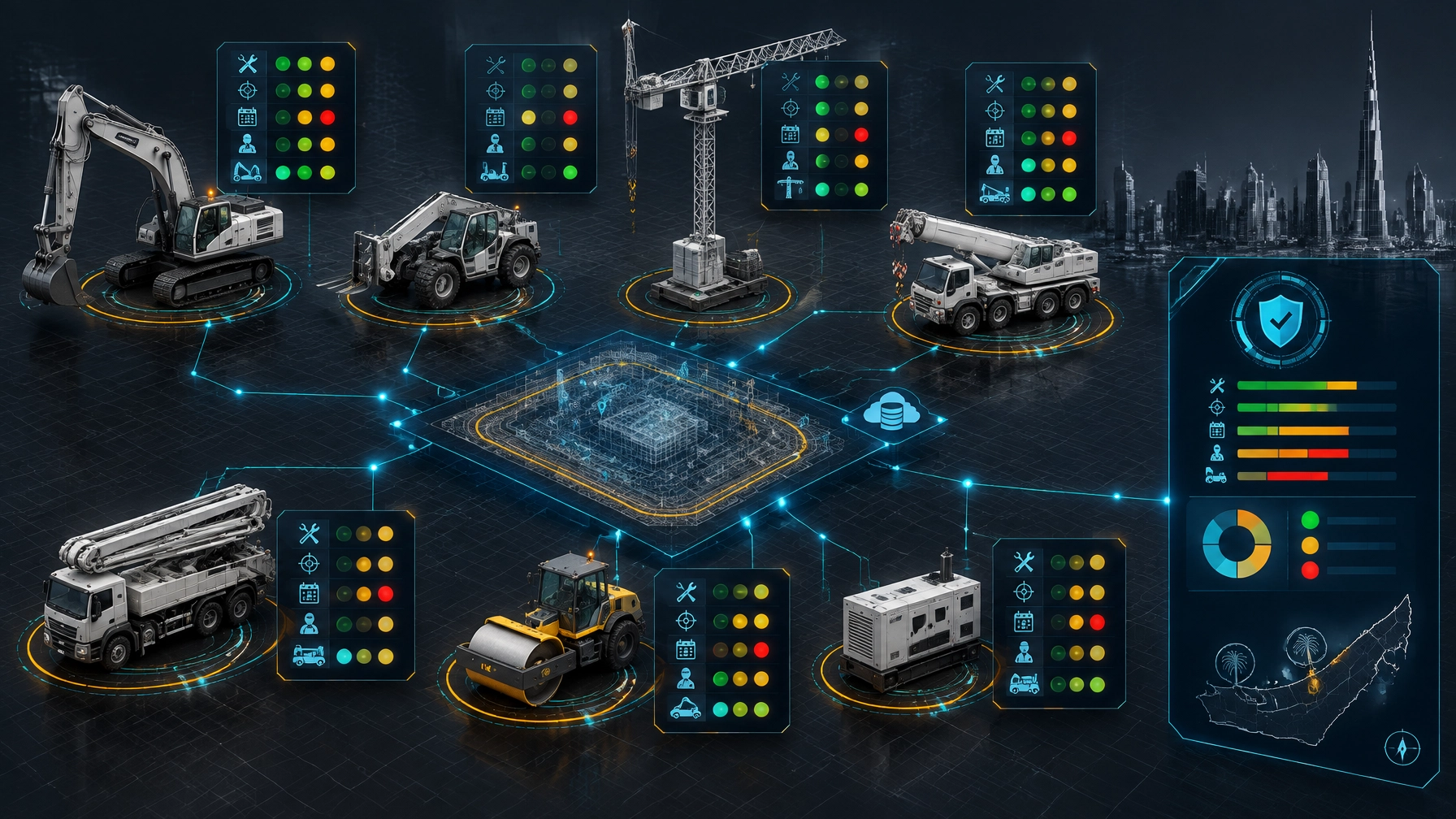
Inspect the components that directly influence output, not only those that determine whether the machine can operate. Check for:
- Worn cutting edges and buckets.
- Excessive movement in pins, bushes and linkages.
- Degraded hydraulic cylinders and hoses.
- Unstable pressure or flow settings.
- Incorrectly functioning load indicators.
- Uncalibrated grade-control systems.
- Defective limit switches or interlocks.
- Deferred maintenance.
- Leaks and contamination.
- Structural repairs without traceable records.
- Non-genuine parts that alter performance or compatibility.
A machine may pass a general visual inspection while failing to hold a construction tolerance. That is particularly relevant where the plant is used as a measuring or positioning system.
Treat load indicators, pressure gauges, grade guidance, flow controls and other monitoring devices as controlled measurement resources. ISO 9001 establishes the broader quality principle: equipment used to demonstrate conformity must be suitable, verified or calibrated where necessary, maintained and supported by retained evidence.
3. Certification is not verification
A licence or operator card is evidence of a credential. It is not, by itself, evidence of current competence on the machine being used.
Certification schemes differ between countries, providers and equipment classes. A third-country licence may be presented for a machine of a different capacity, control arrangement or configuration. A person experienced on a mobile crane may not be competent on a tower crane. A person who has operated an excavator may not be competent to manage a high-precision trimming operation using machine guidance.
Use ISO/IEC 17024 as the benchmark for evaluating the credibility of personnel certification bodies. Then verify the practical match:
- Confirm the machine class.
- Confirm capacity and configuration.
- Confirm the operator’s recent experience.
- Check language comprehension for safety-critical instructions.
- Observe a practical demonstration where the activity is tolerance-critical.
- Document who authorised the operator for the specific task.
For cranes, use ISO 9926-1 as a reference for driver training, ISO 9927-1 for inspection principles and ISO 12480-1 for safe use, planning and competent-person controls.
4. The consequential chain is predictable
The failure sequence is usually not dramatic at the beginning:
- The operator produces a small tolerance drift.
- The deviation is accepted because it appears visually minor.
- A downstream trade cannot install, align or finish its work.
- Rework is instructed under programme pressure.
- The rework is patched, concealed or completed without a full evidence record.
- The defect emerges after handover.
- The client carries the corrective cost while the original cause becomes difficult to prove.
This is where construction compliance becomes a forensic issue. The final defect may appear to be a finishing, concrete, structural or installation problem. The originating cause may be a worn machine component, unsuitable operator allocation or missing calibration record several weeks earlier.
Standard Reference: Build the control system around the machine and the operator
Apply the standards as an integrated control framework rather than as isolated paperwork requirements.
ISO 9926-1: Crane training
Use ISO 9926-1 to establish the training basis for crane drivers. Training should be specific to the crane type and supported by practical competence, not merely attendance at a general induction.
ISO 9927-1: Crane inspections
Use ISO 9927-1 to structure inspection planning and records. Distinguish between pre-use checks, periodic inspections, thorough examinations and inspections triggered by events such as relocation, repair, overload or configuration change.
ISO 12480-1: Safe use of cranes
Use ISO 12480-1 to control planning, selection, operation, maintenance and the appointment of competent personnel. Do not separate the operator from the lift plan, communication protocol and machine configuration.
ISO/IEC 17024: Personnel certification
Use ISO/IEC 17024 to assess the reliability of certification bodies. Treat third-party certification as one evidence layer, then verify the operator’s suitability for the actual plant and task.
ISO 45001: Operational planning and control
Use ISO 45001 to place plant control within the project’s operational planning. Identify risks associated with competence, communication, equipment condition, maintenance, supervision and changes in work conditions.
ISO 9001: Monitoring and measuring resources
Use ISO 9001 principles to control calibration and verification of instruments used to demonstrate conformity. Protect the evidentiary value of grade systems, pressure gauges, load indicators and other measurement devices.

Actionable Fix: Control the operator and the machine as one system
Implement the following controls before tolerance-critical work begins.
Verify the operator against the actual plant
Check and retain:
- Identity and employer details.
- Machine-specific competency evidence.
- Applicable certification class and capacity.
- Recent operating history.
- Medical and fitness evidence where relevant.
- Language capability for safety-critical instructions.
- Practical verification for high-risk or high-precision activities.
Do not accept a generic statement that an operator is “experienced”. Define what experience means for the machine, configuration and task.
Inspect the machine before mobilisation
Require an equipment dossier containing:
- Identification, model and capacity.
- Maintenance history.
- Repair records.
- Inspection certificates.
- Calibration or verification records.
- Safety-device and interlock checks.
- Hydraulic and control-system condition.
- Parts-replacement history.
- Outstanding defects and restrictions.
Repeat the inspection after mobilisation and at defined intervals. Record changes in condition rather than relying on the original hire-company inspection.
Use trial or first-of-type production
Before committing to full production, conduct a controlled trial for critical operations:
- Establish the target tolerance.
- Confirm the operator’s technique.
- Verify the machine setup.
- Check the measurement system.
- Inspect the first output.
- Record corrective adjustments.
- Obtain approval before scaling production.
Use this approach for precision earthworks, high-risk lifts, major concrete placements, piling operations and any activity where correction will become difficult after concealment.
Make pre-start records real
Require the operator to complete a daily pre-start record before operation. Prevent pre-signing by linking the record to:
- The operator.
- The machine identification.
- The shift.
- The work location.
- Defects identified.
- Corrective action.
- Release authority.
Escalate any safety-critical or tolerance-critical defect before production resumes.
Establish an evidence chain
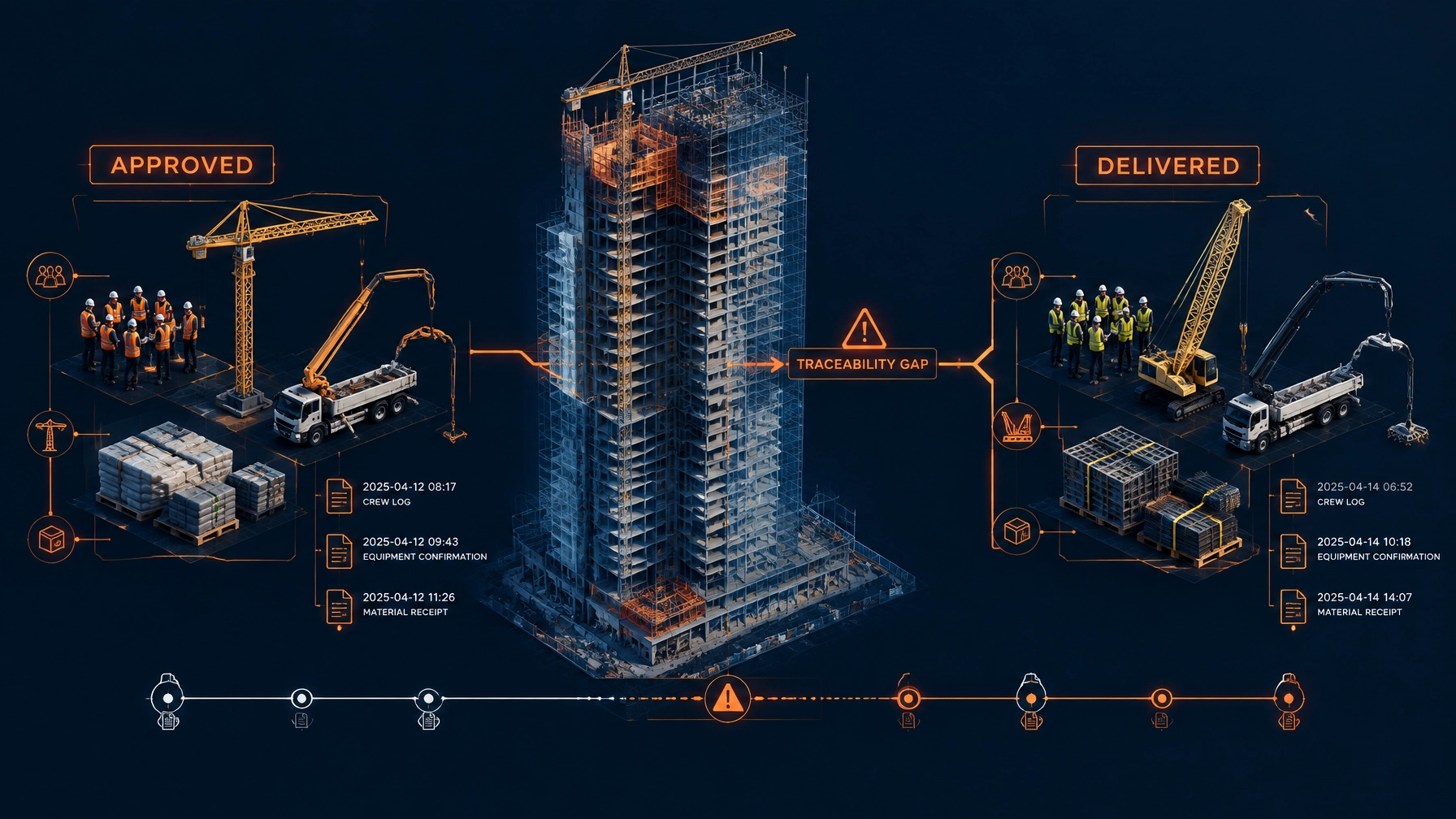
Retain the records that connect the plant to the finished work:
- Operator verification.
- Machine inspection.
- Calibration status.
- Trial results.
- Daily pre-start records.
- Survey or measurement data.
- Production inspection.
- Non-conformance and corrective-action records.
- Approval to conceal or proceed.
This is the evidence required when a dispute develops between the contractor, plant supplier, operator and client.
For Australian builders and project managers working in Dubai, the control objective is straightforward: remove ambiguity before the machine starts producing work. A construction consultant, Client Side Project Management team or construction advisory Australia practice can help establish the verification matrix before responsibility becomes fragmented across multiple subcontractors.
Shoal Bay Projects provides construction compliance, construction risk management services and forensic advisory support for clients who need to distinguish workmanship failure from plant, operator and control-system failure. The same discipline supports a custom home build consultant Australia, a developer’s representative or a building dispute consultant examining the project after the defect has emerged.
Do not ask only whether the plant was available.
Ask whether the plant, operator, method and evidence were capable of producing the required result: repeatedly, measurably and defensibly.
Further reading and advisory support
⚠️ The image in this post is used for illustration purposes only, designed to encourage thoughtful discussion. It is not intended to represent a prescriptive detail of any installation or construction method.
Claim Your Foundation Membership
The Vault. The App. The Community. We're opening the doors to a select group of Foundation Members. Free, for a limited time. Foundation Membership includes full access to The Vault (our forensic intelligence archive) and early access to the Hive app.
Once the charter window closes, this tier is gone permanently. Foundation Members retain access for life. This is not a trial: it's a permanent invitation to the founding cohort.
Claim Your Foundation Membership →
Circle-Ready Companion
Dubai projects do not fail only because an operator makes a mistake. They fail when the project team cannot prove whether the deviation came from the operator, the machine, the setup or the measurement system.
Part 3 of our Dubai series examines the plant operator variable: how equipment competence, machine condition and calibration determine whether tolerance-critical work is genuinely under control.
Full article: The Plant Variable: Why Operator Competence and Machine Condition Decide Tolerance on Dubai Construction Projects
Key forensic takeaways
- A machine can be fully operational and still incapable of holding the required construction tolerance.
- Operator certification is not the same as verification against the specific machine class, capacity and configuration.
- Control the operator, plant condition, calibration, trial production and daily records as one evidence system.
Image assets
⚠️ The image in this post is used for illustration purposes only, designed to encourage thoughtful discussion. It is not intended to represent a prescriptive detail of any installation or construction method.
Claim Your Foundation Membership
The Vault. The App. The Community. We're opening the doors to a select group of Foundation Members. Free, for a limited time. Foundation Membership includes full access to The Vault (our forensic intelligence archive) and early access to the Hive app.
Once the charter window closes, this tier is gone permanently. Foundation Members retain access for life. This is not a trial: it's a permanent invitation to the founding cohort.
Claim Your Foundation Membership →