Construction
May 25, 2026
The Drain Deep Dive: Forensic Sanitary Drainage & NCC 2025
The Drain Deep Dive: Forensic Sanitary Drainage & NCC 2025

The Drain Deep Dive: Forensic Sanitary Drainage & NCC 2025
In the world of residential construction, there is a saying: "Out of sight, out of mind." Unfortunately, for sanitary drainage, this mindset is the quickest way to end up in a legal dispute or facing a five-figure remediation bill. Once the concrete is poured, those pipes aren't just plumbing: they are the permanent infrastructure of the building. If they fail, the building fails.
With the recent release of AS/NZS 3500.2:2025 and the tightening of NCC 2025 performance requirements, the margin for error has effectively vanished. At Shoal Bay Projects, we approach drainage with a forensic lens. It’s not just about making things flow; it’s about ensuring the system performs under pressure for the next 50 years.
The transition from the 2021 to the 2025 standards isn't just a paperwork update; it represents a significant shift in how we manage hydraulic risk, maintenance access, and the integration of new technologies into our homes. Whether you are a builder aiming for a zero-defect handover or a homeowner wanting to protect your investment, understanding these changes is non-negotiable.
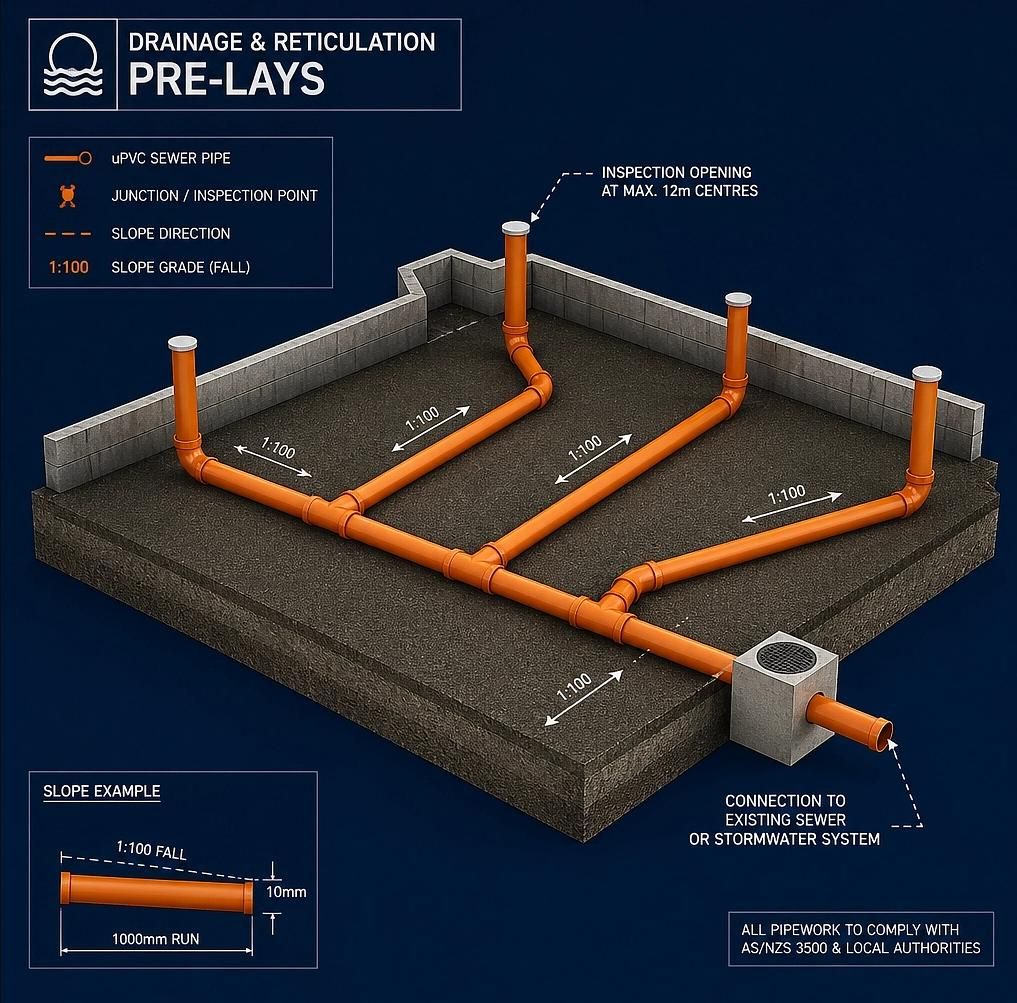
Inspection Openings are the service points that make a drainage system maintainable. Under AS/NZS 3500.2:2025, IO provision is not just a drafting exercise. Check location, spacing, change-of-direction points, and future access before the slab goes down. If the system cannot be inspected, cleared, or tested properly after construction, it is already carrying avoidable risk.
The most common defect we see is simple: the IO exists on paper, but not in a usable form on site. It ends up buried under fill, concealed by paving, or boxed into a corner where no equipment can realistically be used. That usually stays hidden until the first blockage, when a straightforward maintenance task turns into demolition, tracing, and rectification.
Specify IOs where the layout, direction changes, and branch connections require future access in accordance with AS/NZS 3500.2:2025. Keep them accessible. Bring them to finish level where required. Protect them during the build. Document final locations before concrete, paving, or landscaping closes everything in.
Under the new 2025 updates, Section 14 has been revised to provide clearer requirements for main drain lines in multi-unit developments. If you are working on a site with three or more dwellings, the shared drainage infrastructure now requires more explicit documentation regarding access points and sizing to prevent cross-connection issues or maintenance "dead zones."
Pre-lay is the moment that matters. Check trench alignment. Confirm pipe support. Verify that risers are positioned to remain serviceable after slab, external works, and finished ground levels are complete. An IO that cannot be opened or reached is not doing its job. We often use 3D modeling to verify that an IO won't be obstructed by structural footings or future air-conditioning plant.
Reflux valves are there to stop surcharge from pushing sewage back into the building. Under NCC 2025 and AS/NZS 3500.2:2025, they become critical where fixtures are vulnerable to backflow due to their level relative to the sewer network. In plain terms: if the public system surcharges, the house needs protection at the right point and in the right form.
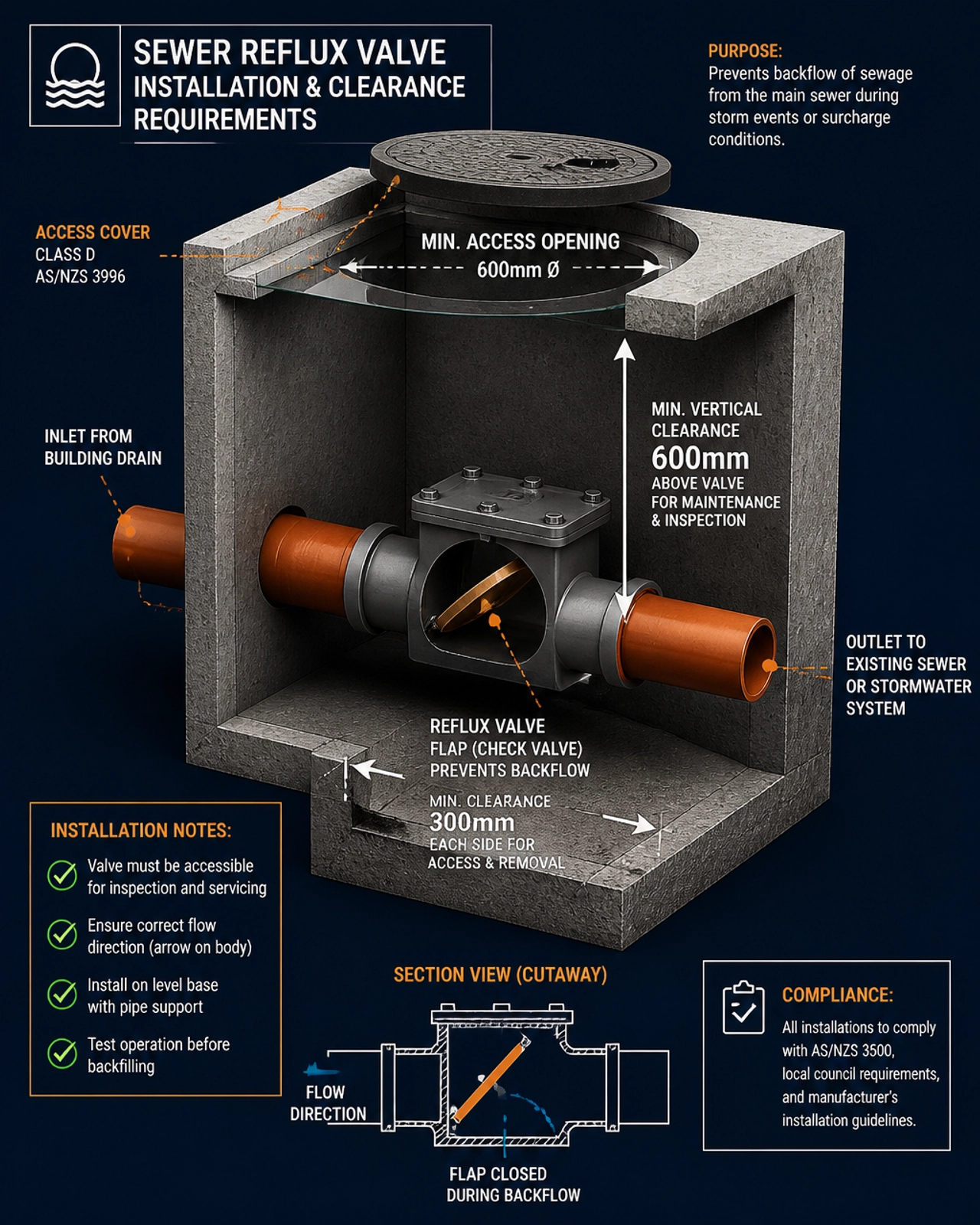
The issue is rarely the idea of the valve. The issue is installation quality and serviceability. We often see valves placed in chambers that are too tight, too deep, or too awkward to inspect properly. That defeats the point. A reflux valve is a mechanical control device. It needs room to operate, room to be checked, and room to be cleaned if debris builds up around the flap.
Confirm trigger conditions under the design. Locate the valve where it protects the relevant fixture or branch. Provide a chamber that allows practical inspection and maintenance. Make sure the direction of flow is unmistakable: installing a reflux valve backward is a catastrophic error that we still see on occasion. Record the installation with high-resolution photos before backfilling.
Treat reflux valves as service items, not buried accessories. If the chamber does not allow a technician to access the flap and clear obstructions, the installation is carrying future failure risk from day one. Under NCC 2025, the performance requirement for "Limiting Damage" is explicitly tied to the maintainability of these mechanical components.
Grades and junction geometry decide whether a sanitary drain performs cleanly or becomes a blockage trap. AS/NZS 3500.2:2025 is built around controlled flow, access, and layouts that reduce turbulence and deposition. This is where on-site discipline matters. Set-out errors of a few millimetres can become long-term defects once buried under a slab.
A major update in the 2025 standard involves junction installation angles. Where there is sufficient height, junctions must now be installed with the branch at least 15° above the horizontal. This is designed to reduce the risk of "hydraulic jump" and splash-back that leads to solid build-up in the branch line.
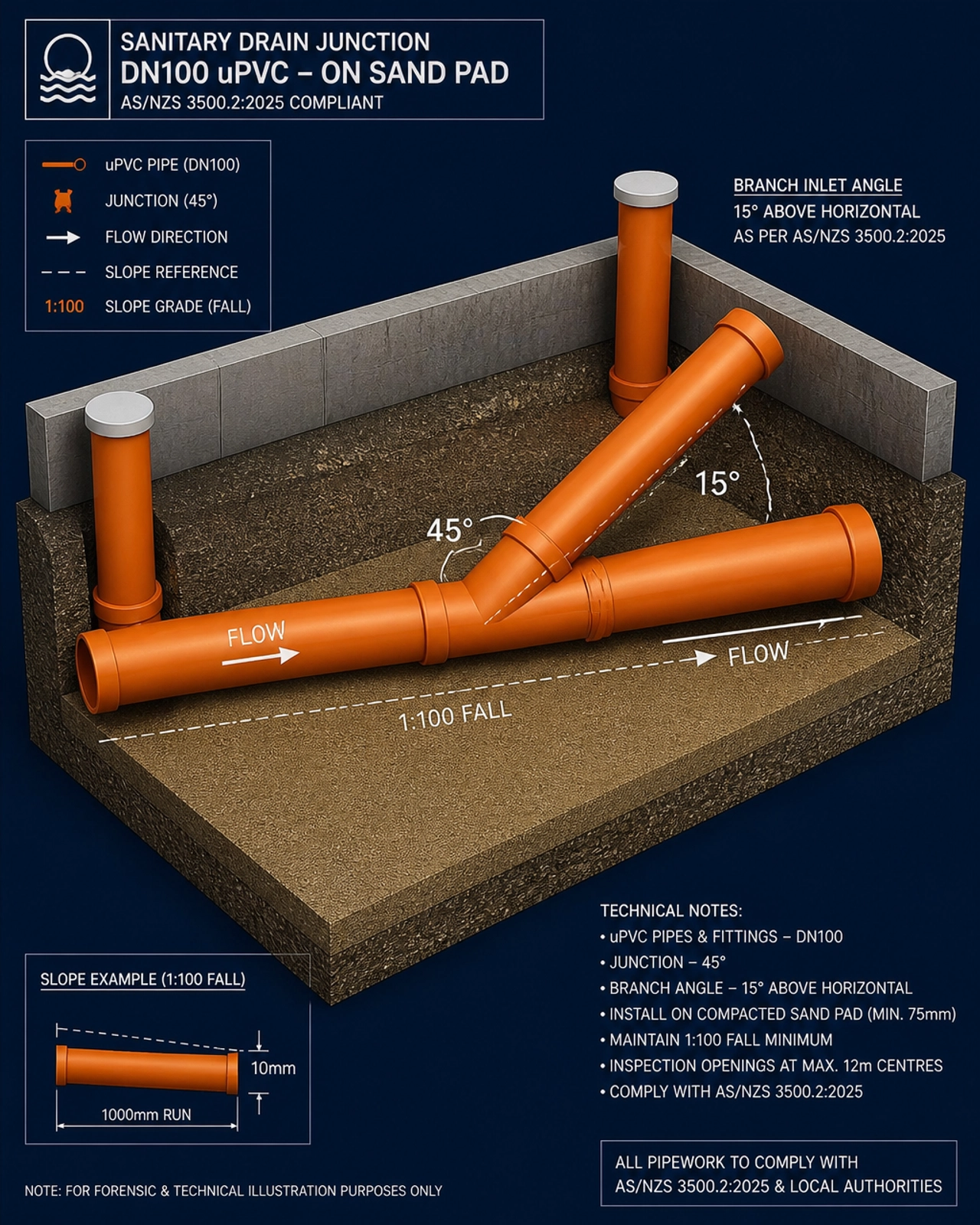
Verify trench preparation before laying. Confirm grades against set-out, not assumptions. Use compliant junction geometry. Re-check levels after placement and again before the pour. If the pipe has slumped, fix it before it disappears forever. A 1:100 grade (1%) is the standard, but consistency is more important than achieving a steeper fall in one spot only to have it flatten out in the next.
We regularly see branch lines tied in with poor geometry or drains that have lost grade because bedding was not stable enough. Once concrete weight or site traffic shifts the line, the system can end up with a local "belly" or flat section. That is where solids start collecting. This is especially critical for low-flow fixtures like high-efficiency toilets where every millimetre of fall counts.
Not every site or building layout fits neatly into a Deemed-to-Satisfy (DTS) pathway. That is exactly where NCC 2025 Performance Solutions come into play. Complex footing geometry, constrained falls, remodelled existing connections, or unusual fixture arrangements can all create situations where the standard layout needs a properly justified alternative.
This is not a licence to improvise on site. It is a formal process. Define the problem. Identify the relevant NCC 2025 Performance Requirements (such as H2P1 for sanitary drainage). Assess the proposed drainage design against AS/NZS 3500.2:2025 principles, hydraulic performance, access for maintenance, and long-term risk. Then document the evidence clearly.
Do not rely on verbal approvals. Document the basis of design. Confirm who is responsible for verification. Keep records of calculations, layouts, product limitations, and inspection requirements. If the solution depends on ongoing maintenance (like a pumped system or a specialized trap), state that plainly in the building's maintenance manual.
Performance Solutions can be the right answer, but only when they are properly structured and defensible. If the system is non-standard, the documentation needs to be stronger, not weaker. We often see "informal" site changes that are later flagged as non-compliant during a forensic audit. Avoid this by formalizing the Performance Solution before the first pipe is laid.
At Shoal Bay Projects, our goal is to catch these issues before they become permanent. A Pre-Slab Advisory review isn't just a "tick and flick." We look at the system as an integrated whole.
The 2025 updates bring several niche but important changes that builders need to be aware of to ensure full compliance:
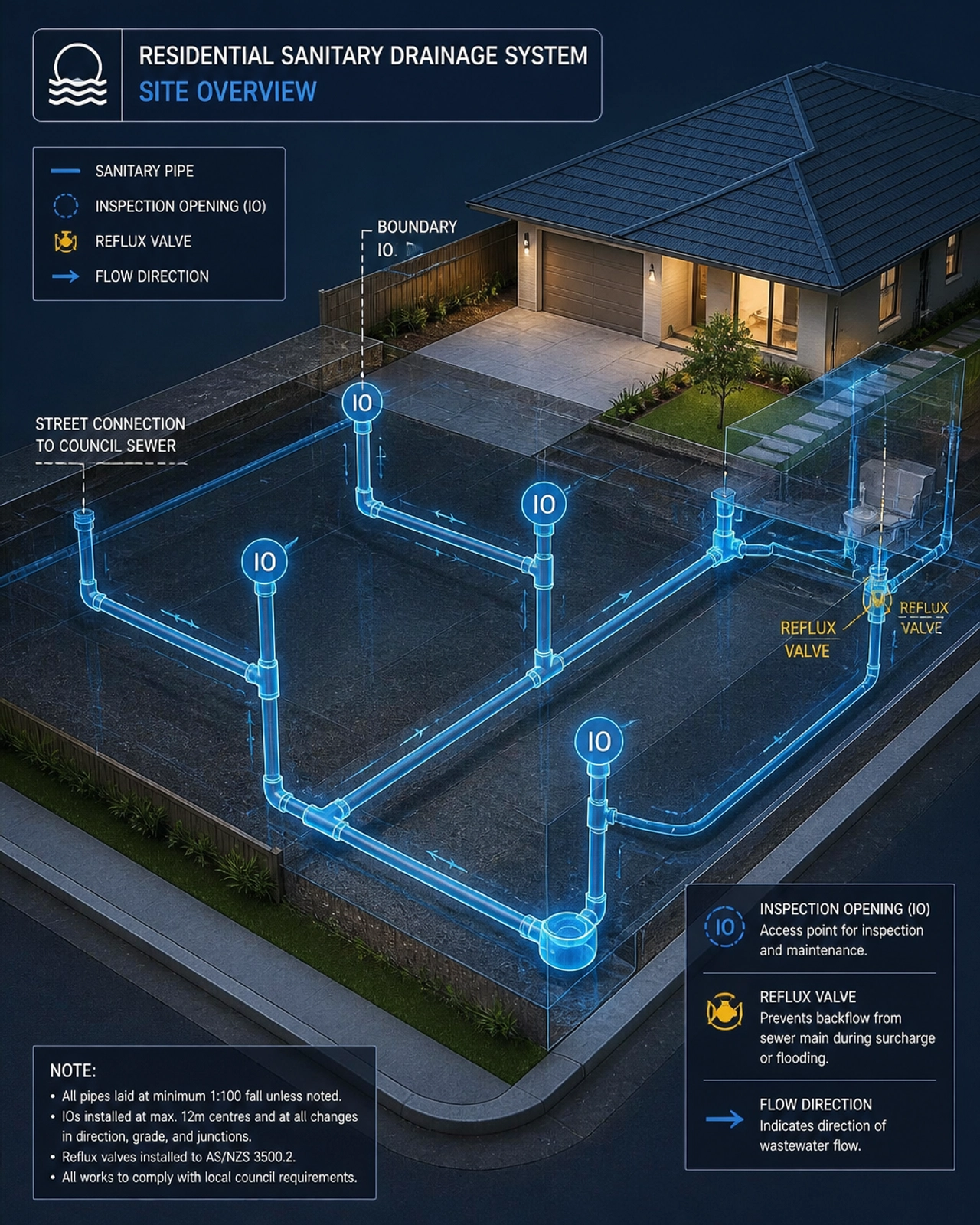
Sanitary drainage is the ultimate "high-stakes" construction element. You get one chance to get it right before it is encased in concrete. By following AS/NZS 3500.2:2025 and the NCC 2025 updates, you aren't just following rules; you are building a system that protects the health of the occupants and the longevity of the structure.
If you’re a builder or developer looking to sharpen your technical edge and avoid the common pitfalls of modern compliance, we invite you to join our community. The Hive is where we share these forensic deep dives, industry updates, and real-world case studies to keep your projects on track.
Explore the community hub here: Welcome to the Hive
Don’t let your drainage become a liability. Whether you need a Pre-Slab Advisory or a Performance Solution for a complex build, Shoal Bay Projects is here to provide the forensic oversight your project deserves.
Email: shoalbayprojectshive@outlook.com
Focus: National Compliance, AS/NZS 3500.2, NCC 2025 Performance.
Stay sharp on-site. The details matter( especially the ones buried under 100mm of concrete.)