Construction
Sep 20, 2026
The Competence Assumption: Why a Trade Title Is Not Evidence of Skill on Dubai Construction Projects
The Competence Assumption: Why a Trade Title Is Not Evidence of Skill on Dubai Construction Projects

The Competence Assumption: Why a Trade Title Is Not Evidence of Skill on Dubai Construction Projects
On a Dubai construction project, a worker may be recorded as a carpenter, steel fixer, tiler, welder, electrician or foreman. That title may appear on a manpower schedule, subcontractor submission, site access register or competency matrix.
It still does not prove that the individual can perform the task to the required standard.
Dubai’s workforce is assembled from multiple countries, training systems and employment pathways. Within one trade, individuals may hold a recognised national qualification, a private training-centre certificate, an employer-issued competency card or no formal credential at all. The documentation may be genuine, but the level of competence may remain unclear.
The title is not a standardised unit of capability.
This is the first control failure for Australian builders, project managers, owner’s representatives and developers entering the Dubai and wider UAE market. Management capability is inferred from the subcontractor’s company profile. Crew competence is inferred from the main contractor’s reputation. A supervisor’s skill is inferred from the fact that the work has been released for construction.
Those inferences are not evidence.
The risk becomes acute on high-end residential and mixed-use projects where the required outcome depends on tolerance, sequence and interface control. Setting out, structural steel alignment, stone, tiling, joinery, waterproofing, screed and façade installation can fail long before the defect is visible to a client.
The resulting claim is often described as poor workmanship.
The underlying failure is usually earlier: competence was assumed during procurement instead of being assessed against the task.
The difference between two people carrying the same trade title can be substantial. A first-class fabricator and an inexperienced helper may both be recorded as “steel fixer”. Their productivity, tolerance capability, interpretation of drawings and defect rates may differ by multiples, not percentages.
The same pattern applies to:
A crew can complete work quickly while producing a steadily expanding defect population. The speed of installation then becomes falsely associated with competence.
Do not measure competence by output volume alone. Measure the quality, repeatability and traceability of the output.
Language differences are not limited to verbal communication. They affect how instructions are interpreted, confirmed and transferred between levels of the site organisation.
A technical instruction may pass through:
At each transfer, the instruction can lose dimensions, tolerances, sequence requirements or hold-point conditions.
A worker may respond affirmatively because the instruction is understood socially, not technically. A foreman may confirm that a task is complete because the crew has installed the component, not because the installation has achieved the specified tolerance. A translated method statement may preserve the words while losing the technical intent.
Treat silence, agreement and completion status as communication events requiring verification. Do not treat them as proof of understanding.
A competency certificate has value only when its origin, scope and relevance can be established.
Ask:
A welding qualification illustrates the problem. A welder qualified for one process and position is not automatically qualified for every process and position. A certificate may be valid for a limited range of material thicknesses, joint configurations or welding conditions.
The same principle applies outside welding. A tiler who can install standard-format ceramic tiles may not be competent to set large-format stone across a tolerance-sensitive feature wall. A carpenter experienced in rough framing may not be competent to install high-value architectural joinery. A plant operator familiar with one machine type may not be competent to operate another with different controls, load charts or visibility limitations.
Verify capability against the actual task.
The competence of a supervisor is often inferred from the work produced by the crew. This is the supervisor halo.
The supervisor may be technically strong, but may also be managing several crews across multiple floors. Physical presence may be intermittent. Inspection records may be completed after the work has progressed. Instructions may be issued centrally while installation decisions are made locally.
A supervisor’s title does not prove continuous control of the work.
Separate three questions:
Do not allow a strong supervisor to become a substitute for task-level verification.
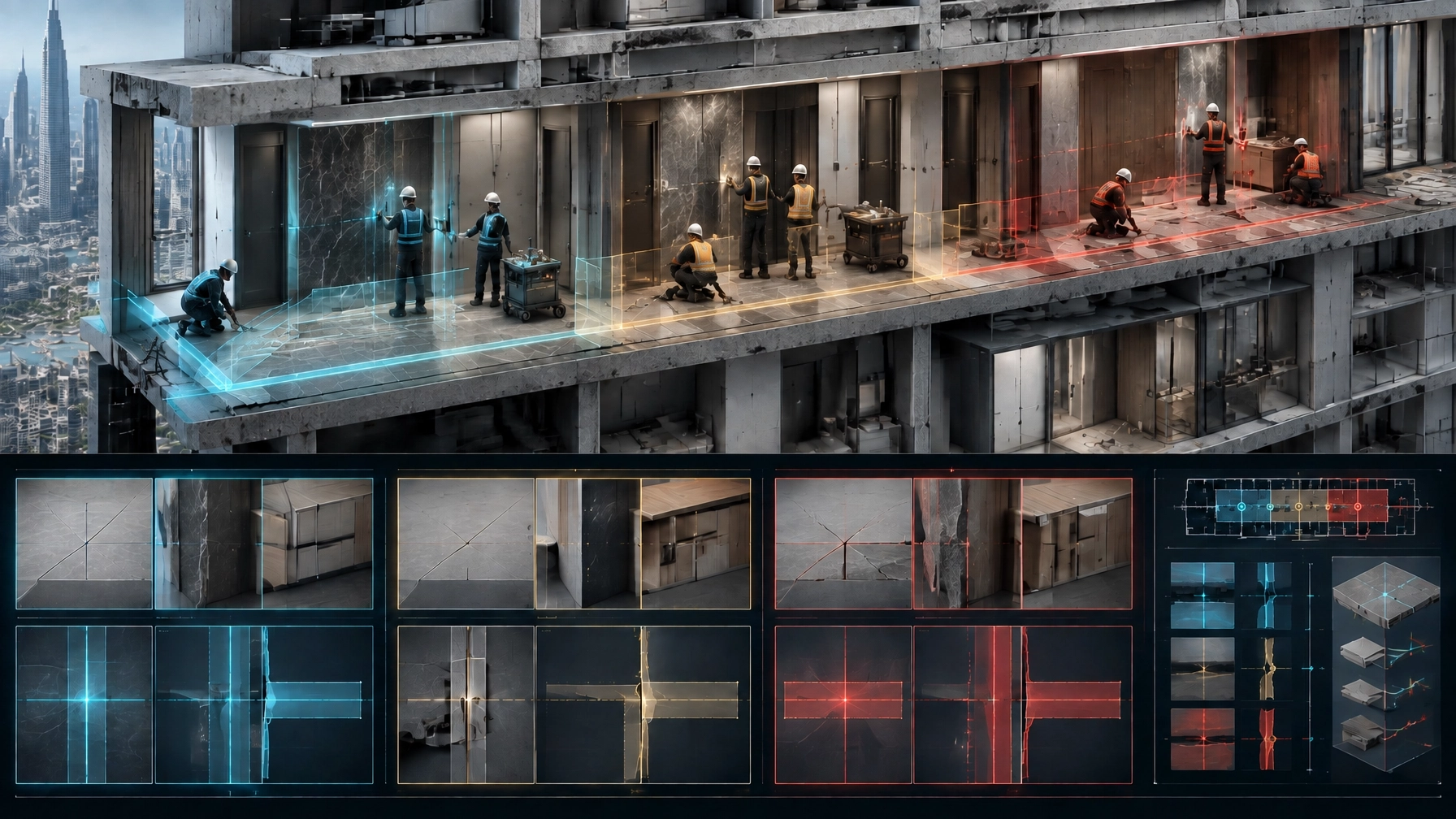
The skill gradient becomes visible where the completed work must align with adjacent work, fixed reference points or strict visual expectations.
Typical failure patterns include:
These defects often create conflict between the contractor’s view of acceptable finish and the consultant’s view of required performance.
The contractor may argue that the work is visually acceptable. The consultant may identify dimensional nonconformance, inadequate interface preparation or a failure to follow the approved sequence.
The dispute then becomes a matter of opinion because no objective competence evidence was captured before production began.
A post-completion inspection cannot reliably determine which crew made a concealed decision, used an incorrect method or introduced an alignment error.
Record competence before the work disappears behind finishes or progresses into the next trade.
Link each critical activity to:
This changes the investigation question from “Who was on site?” to “Which verified team performed this work, under which instruction, and with what inspection evidence?”

International standards provide a useful framework for separating organisational claims from individual competence.
ISO/IEC 17024 establishes requirements for bodies that certify people. Its importance is independence, defined competence criteria, assessment controls and confidence in the certification process.
Use it to distinguish an independently assessed competency certificate from an internal employer-issued card.
ISO 9001 requires organisations to determine necessary competence, ensure people are competent and retain appropriate documented information.
ISO 9001 does not prove that every operative is capable of a particular task. It does require the contractor’s management system to define how competence is determined, maintained and evidenced.
Treat a quality certificate as evidence of a system framework, not as a substitute for a trade test.
ISO 9606-1 demonstrates why trade competence must be task-specific. Welder qualification depends on the process, material, joint type, position and applicable qualification range.
Do not accept a generic welding certificate without comparing its scope to the welds shown in the approved fabrication and erection documentation.
ISO 3834 addresses quality requirements for fusion welding of metallic materials. It supports controls for procedures, personnel, inspection, documentation and production quality.
Require the fabricator to show how individual qualification links to the welding quality system.
EN 1090-2 provides technical requirements for the execution of steel structures, including production controls, tolerances and competence-related execution requirements.
Use it as a reference when assessing whether a steelwork team can produce the required structural outcome, rather than relying on job titles or years of claimed experience.
ISO 45001 requires organisations to address competence, training and awareness for work that can affect occupational health and safety.
Safety-critical plant, lifting and access activities require the same discipline as quality-critical trades: define the task, verify the operator and retain the evidence.
Replace broad categories such as “tiler” or “welder” with task-specific descriptions.
State the material, equipment, tolerance, sequence, interface and inspection requirement. Assess the person against that defined activity.
Require practical trade testing for tolerance-critical scopes before approving the subcontractor’s production crew.
Use practical assessments for setting out, stone, tiling, joinery, welding, waterproofing, screed and façade installation. Record the result, assessor, date, task and acceptance criteria.
Check the issuing organisation, certificate number, assessment scope, identity, expiry and verification pathway.
Translate documents where required, but do not confuse translation with validation. A translated certificate remains unverified if its issuing body cannot be traced.
Require a representative sample panel or mock-up. Inspect it for dimensional control, finish, interface quality and repeatability.
Do not approve a mock-up based only on appearance. Check the installation sequence and the hidden preparation that will be concealed in production.
Inspect the first completed unit of each work type before releasing the crew to repeat the process across the floor or project.
Use the first unit to confirm that the team has understood the drawings, method statement, tolerances and interface requirements.
Record the operative group, foreman, date, work zone and relevant inspection release.
If crews change, reverify the first unit. Do not assume that a replacement team has inherited the competence of the previous team.
Record where and when the supervisor is present. Identify the number of crews and zones under direct control.
Escalate when one supervisor is responsible for more work fronts than can be practically inspected. Management span is a construction risk, not an administrative detail.
Maintain one register containing:
This is where a construction consultant, residential building consultant or Client Side Project Management team adds measurable value. The objective is not to create paperwork. The objective is to prevent an untested assumption from becoming a concealed defect, delay event or building dispute.
Shoal Bay Projects provides building consultancy services, construction advisory and residential project support for clients requiring stronger construction compliance, construction risk management services and forensic control across complex projects.
Assess the person. Test the task. Name the crew. Trace the result.

⚠️ The image in this post is used for illustration purposes only, designed to encourage thoughtful discussion. It is not intended to represent a prescriptive detail of any installation or construction method.
Explore further construction advisory and forensic compliance intelligence through The Hive YouTube channel.
The Vault. The App. The Community. We're opening the doors to a select group of Foundation Members. Free, for a limited time. Foundation Membership includes full access to The Vault (our forensic intelligence archive) and early access to the Hive app.
Once the charter window closes, this tier is gone permanently. Foundation Members retain access for life. This is not a trial: it's a permanent invitation to the founding cohort.
Claim Your Foundation Membership →
A trade title tells you what someone is called on the project. It does not prove what they can reliably deliver.
On Dubai projects, language barriers, varied training pathways and steep differences in individual capability can turn a simple procurement assumption into a concealed quality failure. The key is to assess competence against the task, not the label attached to the worker.
Read the full article:
The Competence Assumption: Why a Trade Title Is Not Evidence of Skill on Dubai Construction Projects
Open The Hive
⚠️ The image in this post is used for illustration purposes only, designed to encourage thoughtful discussion. It is not intended to represent a prescriptive detail of any installation or construction method.
The Vault. The App. The Community. We're opening the doors to a select group of Foundation Members. Free, for a limited time. Foundation Membership includes full access to The Vault (our forensic intelligence archive) and early access to the Hive app.
Once the charter window closes, this tier is gone permanently. Foundation Members retain access for life. This is not a trial: it's a permanent invitation to the founding cohort.