Construction
Jul 20, 2026
Sealed Insulated Metal Panel Base Conditions: Why Scope Gaps Between Trades Drive Field Failures
Sealed Insulated Metal Panel Base Conditions: Why Scope Gaps Between Trades Drive Field Failures

Sealed Insulated Metal Panel Base Conditions: Why Scope Gaps Between Trades Drive Field Failures
In the hierarchy of building envelope failures, the base condition of an Insulated Metal Panel (IMP) system represents a unique forensic category: the "no-man’s land" of construction. While IMP systems are often marketed as high-performance, single-component solutions for thermal continuity, their actual field performance is dictated by the interface at the slab edge: a transition that sits at the convergence of three separate trades.
When specification language is ambiguous, this interface becomes a scope gap. No single party holds explicit responsibility for the four critical control layers: air, water, thermal, and pest: resulting in failures that are often invisible until they are catastrophic.
A forensic investigation of a cold-storage facility in the upper Midwest provides a clinical look at how these gaps manifest. Within 18 months of completion, the facility exhibited recurring frost heave at the base of the wall, visible condensation tracking along the interior slab edge, and evidence of rodent entry.
The root cause was a seemingly negligible 3/8-inch undocumented gap between the panel’s foam core and the slab edge flashing.
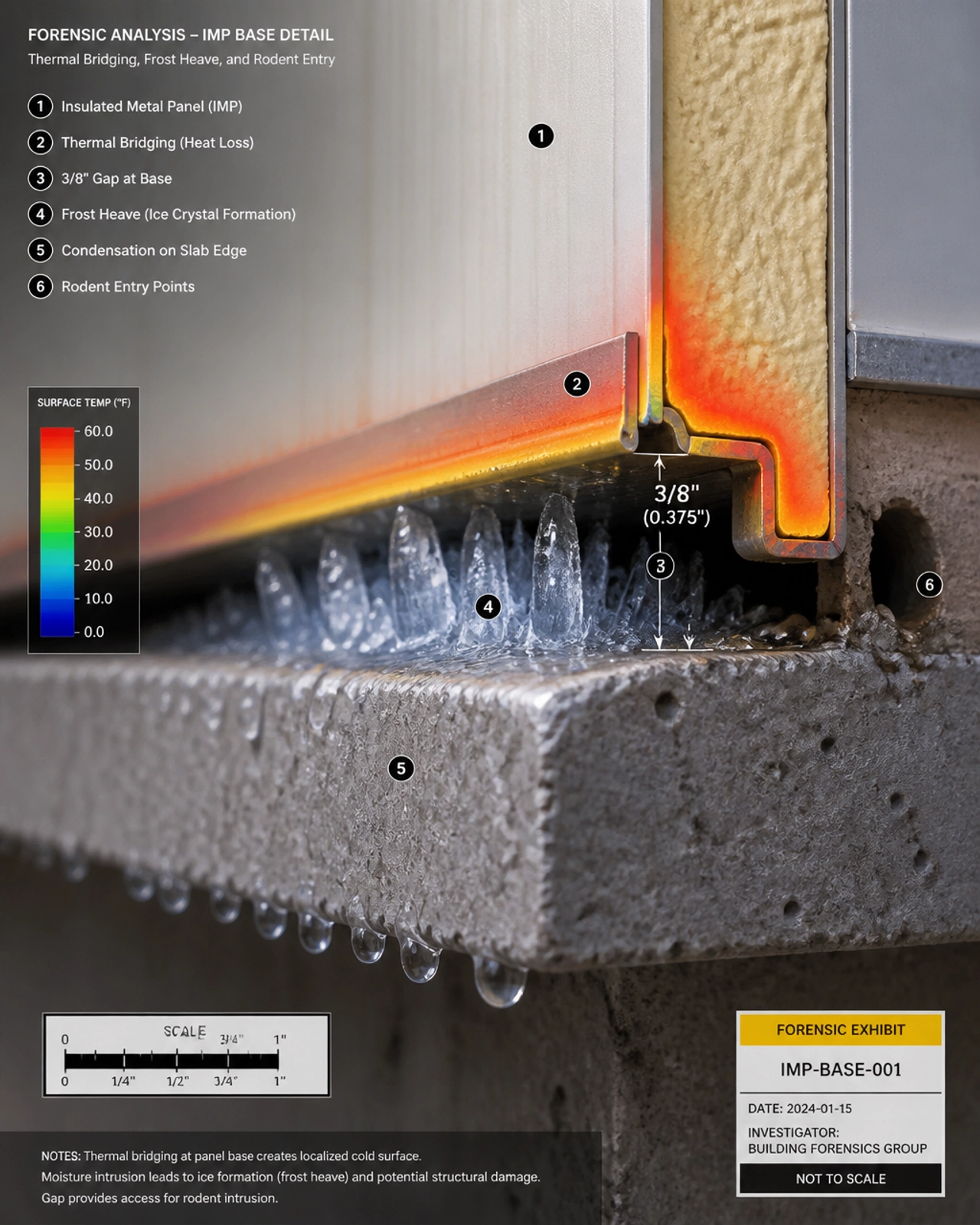
This gap served as a primary infiltration pathway for warm, humid exterior air. In a cold-storage environment, the dew point is reached almost instantly upon contact with the refrigerated slab, saturating the slab edge insulation and migrating inward. In freeze-thaw cycles, this trapped moisture expands, exerting lateral pressure that widens the gap further. What began as a 3/8-inch void grew to nearly 5/8-inch in several bays, accelerating the failure loop.
Field improvisation at the base condition is often a reaction to conflicting tolerances. According to ACI 117-10 Section 4.8.1, the formed slab edge tolerance is specified at plus or minus 3/4 inch. This means the gap between the panel’s bottom rail and the slab face can vary by 1.5 inches across a single building perimeter.
A fixed-dimension detail drawn to a nominal 1-inch gap cannot handle this variance. Without a flexible, specified closure system, installers will fill this void with whatever backer material is available on-site, or worse, ignore the variation and leave the foam core exposed.
The performance requirement for the IMP base is no longer a matter of "best practice"; it is a code-mandated liability. ASHRAE 90.1-2022 Section 5.4 makes slab edge insulation a compliance requirement in Climate Zones 4 through 8.
When the base condition is built without thermal continuity, the building fails its continuous insulation (CI) requirement. THERM modeling of a typical 4-inch concrete slab edge without insulation in Climate Zone 6 shows a linear thermal transmittance (psi value) of approximately 0.8 BTU/hr-ft-F. This represents a massive energy penalty concentrated in a 6-inch-wide zone running the full perimeter of the building.
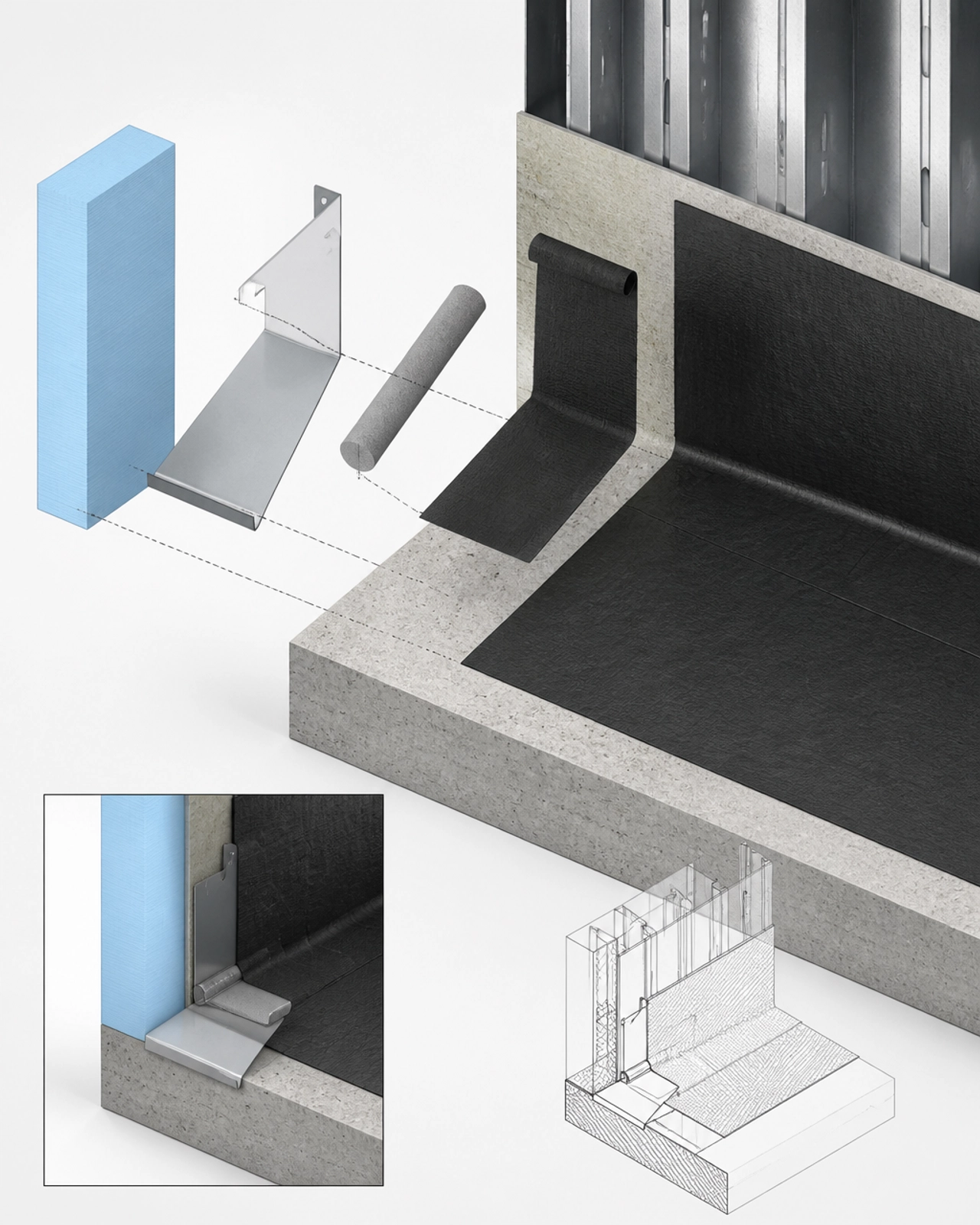
To prevent field failures, the base condition must be detailed as a sequence of four distinct components, each with a named trade assignment in the project manual.
One of the most dangerous risks for a building owner is the "warranty exclusion alignment." An IMP manufacturer’s warranty typically covers panel-to-panel joints and factory coatings. However, the base condition interface is explicitly excluded as a "field-fabricated condition."
When the specification leaves a scope gap at the exact physical location where the manufacturer excludes coverage, the owner is left with no contractual remedy. The general contractor points to the IMP installer, the installer points to the slab tolerance, and the flashing contractor claims the interface was never in their bid.
Documenting the detail is necessary but insufficient. To convert sequencing into an enforceable obligation, a pre-installation conference must be held with signed trade acknowledgments from the IMP installer, the concrete contractor, and the sheet metal contractor.
The agenda must establish "hold points": defined inspection triggers where the work of one trade (e.g., the base flashing) must be approved before the next trade (e.g., the IMP installer) can proceed. This converts "coordination" from a vague aspiration into a contractual record.

Building a high-performance envelope requires closing the gaps between trades as much as closing the gaps between panels.
The Vault. The App. The Community. We're opening the doors to a select group of Foundation Members — free, for a limited time. Foundation Membership includes full access to The Vault (our forensic intelligence archive) and early access to the Hive app.
Once the charter window closes, this tier is gone permanently. Foundation Members retain access for life. This is not a trial — it's a permanent invitation to the founding cohort.
[Claim Your Foundation Membership →]
⚠️ The image in this post is used for illustration purposes only, designed to encourage thoughtful discussion. It is not intended to represent a prescriptive detail of any installation or construction method.
Subject: Why IMP Base Conditions are the "No-Man's Land" of Building Enclosures
"Sealed IMP Base Conditions: Why Scope Gaps Between Trades Drive Field Failures"
Full article: [Link to Blog Post]
We've all seen it: the architectural drawing looks perfect, but the field execution is a disaster of shims and caulk. This week, we’re looking at why Insulated Metal Panel (IMP) base conditions fail: not because of the product, but because of the "Invisible Void" left between trades.
Key Forensic Takeaways:
Check out the technical 3D forensic breakdowns in the full post below.
[Link to Blog Post]
The Vault. The App. The Community. We're opening the doors to a select group of Foundation Members — free, for a limited time. Foundation Membership includes full access to The Vault (our forensic intelligence archive) and early access to the Hive app.
Once the charter window closes, this tier is gone permanently. Foundation Members retain access for life. This is not a trial — it's a permanent invitation to the founding cohort.
[Claim Your Foundation Membership →]