Construction
Jul 8, 2026
Concrete Cancer Rectification: The Engineered Repair Approach
Concrete Cancer Rectification: The Engineered Repair Approach

Concrete Cancer Rectification: The Engineered Repair Approach
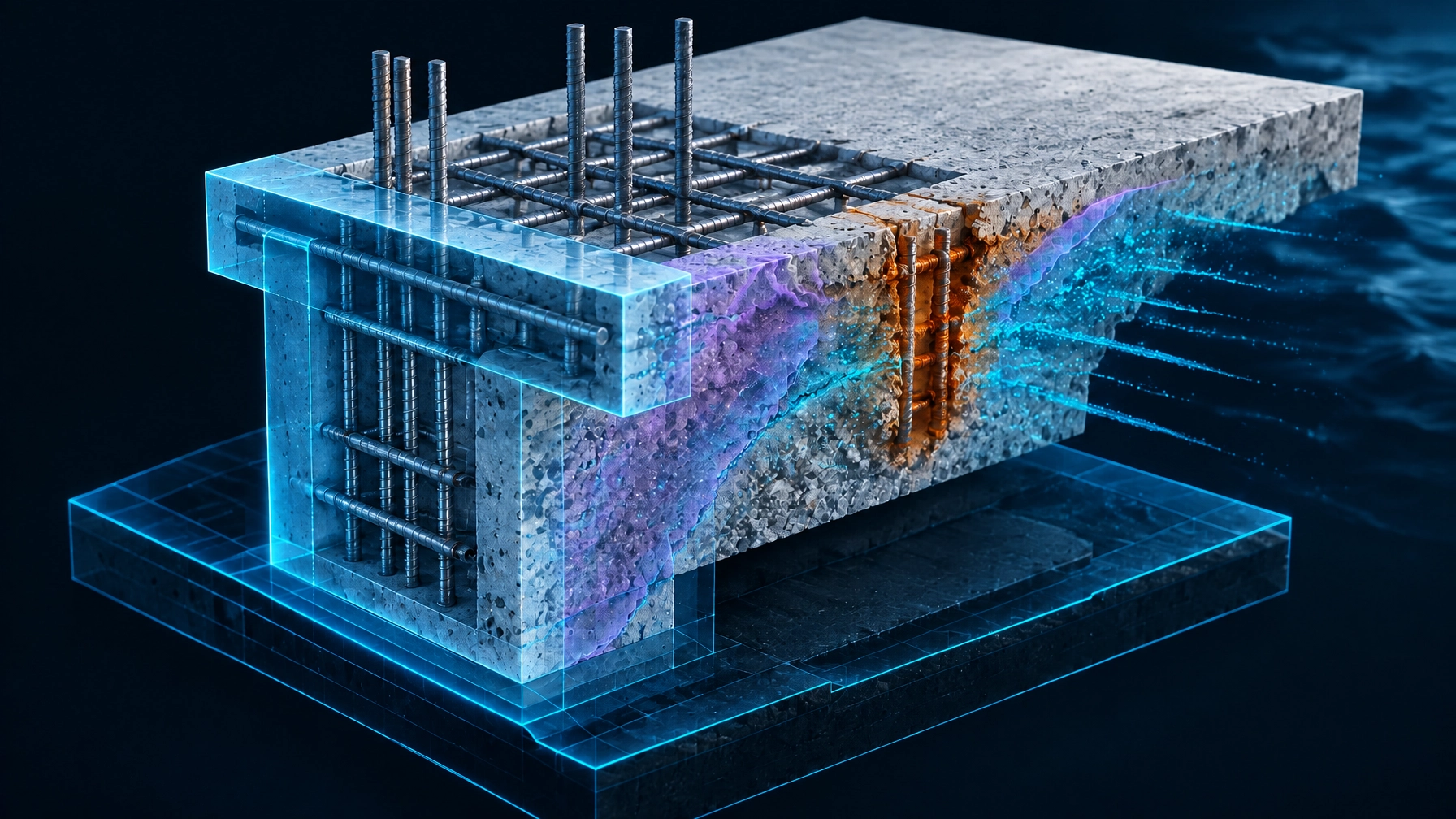
In the high-chloride environments of Perth and the Western Australian coastline, "concrete cancer": or chloride-induced reinforcement corrosion: is not merely a maintenance nuisance; it is a structural liability. For Builders and Strata Managers, the transition from identifying a spall to executing a permanent rectification requires moving beyond cosmetic "patching" toward a forensic, engineered repair chain.
At Shoal Bay Projects, we observe that failure in remediation usually stems from a lack of adherence to the EN 1504 framework. A successful repair must manage the electrochemical environment of the steel, not just the physical appearance of the concrete.
A compliant repair starts with the aggressive removal of contaminated material. Following EN 1504 Principle 3 (Concrete Restoration), breakout must continue until sound, non-carbonated concrete is reached. In coastal WA, this often means breaking back significantly further than the visible crack to ensure the chloride front is fully bypassed.
Document the Breakout: Ensure the concrete is removed to a depth of at least 15–20mm behind the reinforcement. This allows the repair mortar to fully encapsulate the bar, restoring the mechanical bond and the alkaline passivity required by AS 3600.
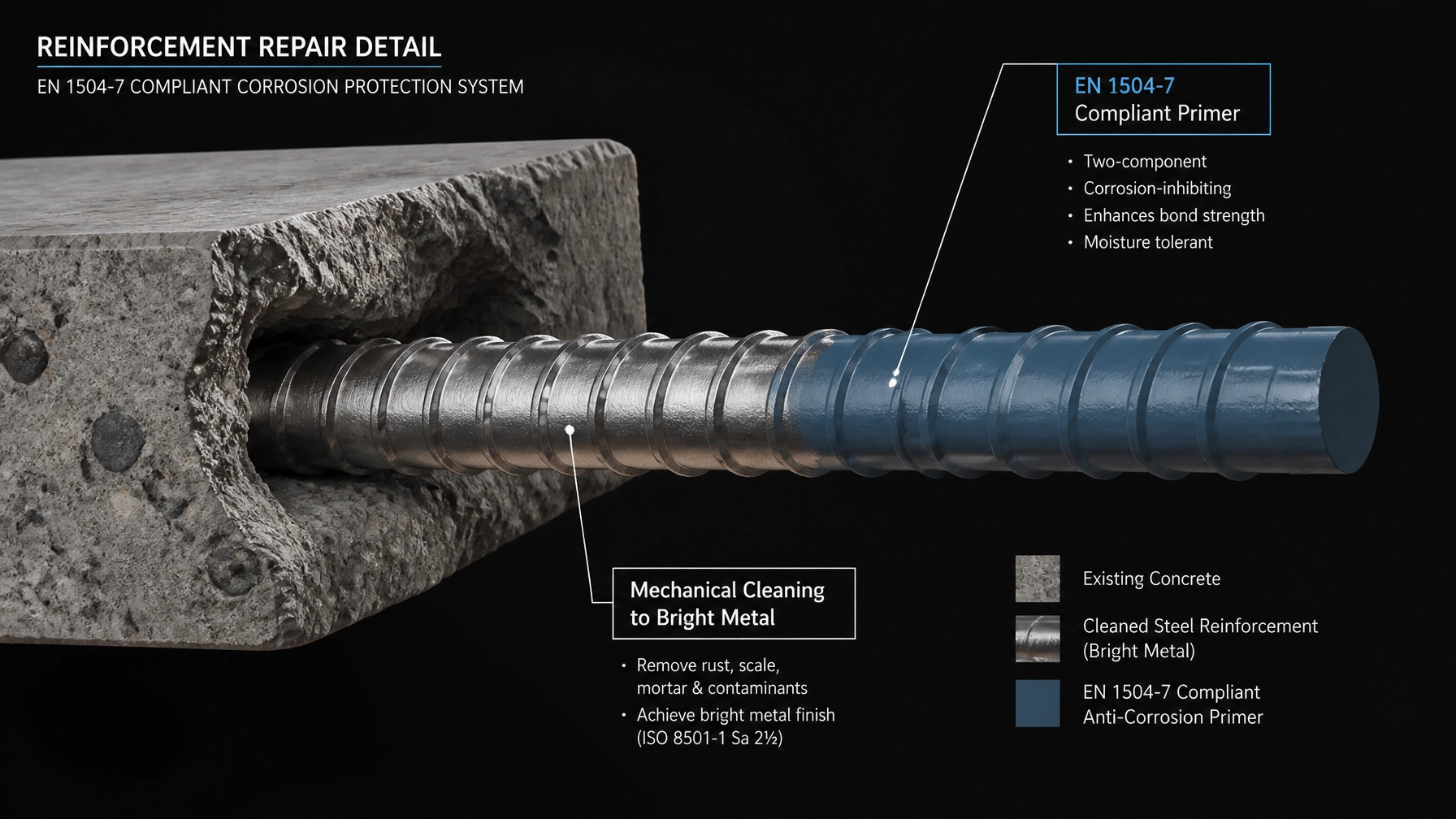
Once exposed, the reinforcement must be treated with clinical precision. Mechanical cleaning to "bright metal" (Class 2.5 abrasive blast or equivalent) is non-negotiable.
Specify and apply a corrosion-preventative reinforcement coating compliant with EN 1504-7. These primers act as a secondary barrier, but their primary role is to provide a consistent electrochemical interface for the subsequent repair mortars. If section loss on the rebar exceeds 20%, structural engineering intervention is required to determine if supplementary reinforcement (N-bars) must be spliced in accordance with AS 3600 lap length requirements.
The most common failure in Perth strata remediation is the "Halo Effect," or incipient anode effect. When you place a highly alkaline, chloride-free repair mortar (R3 or R4 Class) adjacent to old, chloride-contaminated concrete, you create a massive electrochemical potential difference.

The result: The steel just outside the repair zone becomes the new anode and begins to corrode at an accelerated rate.
To mitigate this, Sacrificial Anodes (discrete galvanic anodes) must be installed. These zinc-cored units are tied directly to the cleaned reinforcement at the perimeter of the patch. In accordance with AS 2832.5, these anodes sacrifice themselves to protect the adjacent steel, effectively "drawing" the corrosion away from the structural reinforcement.
The selection of repair mortars must align with the structural requirements of the element.
In the Perth coastal context, the repair is not complete until the entire element is protected against future ingress. High-build anti-carbonation coatings (compliant with EN 1504-2) should be applied over the entire surface. These coatings allow the concrete to "breathe" (vapor permeable) while blocking the diffusion of CO2 and liquid water, significantly extending the service life of the repair.

For widespread contamination where patch repairs and anodes are insufficient, full Cathodic Protection (CP) systems designed under AS 2832.5 may be necessary. This moves the strategy from reactive maintenance to active asset management.
At Shoal Bay Projects, we provide the forensic advisory bridge between the physical defect and the engineered solution. We ensure that your remediation contractors are not just filling holes, but are following a compliant, technical chain of custody that protects the long-term integrity of the structure.
Explore more technical insights and community discussions on high-end residential and commercial compliance at The Hive.
Welcome to the Hive - Watch Now
⚠️ The image in this post is used for illustration purposes only, designed to encourage thoughtful discussion. It is not intended to represent a prescriptive detail of any installation or construction method.